The Dark Nameless One by Fiona Macleod
“The Dark Nameless One” is taken from the Fiona Macleod anthology The Washer of the Ford and Other Legendary Moralities, first published in 1896 by Patrick Geddes (Celtic Library). It’s one of eight stories in the author’s Legendary Moralities series.
In 1910, “The Dark Nameless One” was republished in the combination anthology The Sin-Eater, the Washer of the Ford and Other Legendary Moralities.
About Fiona Macleod
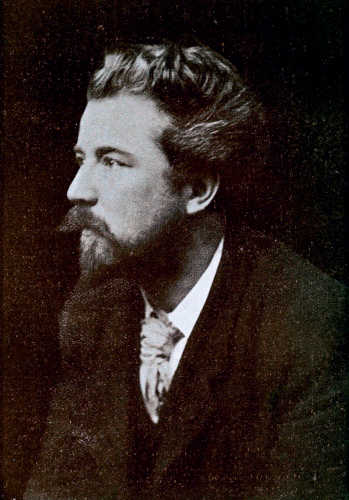
Fiona Macleod was the pen name used by the Scottish writer and poet William Sharp, who successfully kept his nom de plume secret until his death. Sharp also wrote under his own name, but the work he put his name to was very different from the creative endeavors he published as Fiona Macleod, and not nearly so successful.
Sharp was born 12 September 1855 in Paisley, and was educated at Glasgow Academy. He also attended the University of Glasgow, from 1871 to 1872, but left without completing a degree. Eighteen seventy-two was also the year Sharp contracted typhoid fever, but it’s unclear whether this was the reason why he failed to continue his education.
In 1874, Sharp began working in the office of a Glaswegian law firm. He remained there until 1875. The following year, due to health issues, he went on a voyage to Australia, and, by 1878, was living in London, where he began working for a bank.
In 1884, Sharp married his cousin Elizabeth Sharp and, at some point took up writing, taking up the pen full-time from 1891 onward. Around this time, he became emotionally involved with, fellow writer, Edith Wingate Rinder, a married woman who was the inspiration behind the work he produced as Fiona Macleod. Notably, his first Fiona Macleod book, Pharais: A Romance of the Isles (1894) was dedicated to “E. W. R.” (Edith Wingate Rinder).
As Fiona Macleod, Sharp wrote three novels, and an impressive amount of short fiction and poetry, writing especially prolifically between 1894 and 1896, producing his first two novels and two anthologies of shorter works of speculative fiction. He died 12 December 1905, at the Castello di Maniace in Sicily—while visiting Sir Alexander Nelson Hood, 5th Duke of Bronté—and was interred in the ducal cemetery.
The Dark Nameless One
by Fiona Macleod
(Online Text)
One day this summer I sailed with Padruic Macrae and Ivor McLean, boatmen of Iona, along the southwestern reach of the Ross of Mull.
The whole coast of the Ross is indescribably wild and desolate. From Feenafort (Fhionn-phort) opposite Balliemore of Icolmkill, to the hamlet of Earraid Lighthouse, it were hardly exaggeration to say that the whole tract is uninhabited by man and unenlivened by any green thing. It is the haunt of the cormorant and the seal.
No one who has not visited this region can realise its barrenness. Its one beauty is the faint bloom which lies upon it in the sunlight—a bloom which becomes as the glow of an inner flame when the sun westers without cloud or mist. This is from the ruddy hue of the granite, of which all that wilderness is wrought.
It is a land tortured by the sea, scourged by the sea-wind. A myriad lochs, fiords, inlets, passages, serrate its broken frontiers. Innumerable islets and reefs, fanged like ravenous wolves, sentinel every shallow, lurk in every strait. He must be a skilled boatman who would take the Sound of Earraid and penetrate the reaches of the Ross.
There are many days in the months of peace, as the islanders call the period from Easter till the autumnal equinox, when Earraid and the rest of Ross seem under a spell. It is the spell of beauty. Then the yellow light of the sun is upon the tumbled masses and precipitous shelves and ledges, ruddy petals or leaves of that vast Flower of Granite. Across it the cloud shadows trail their purple elongations, their scythe-sweep curves, and abrupt evanishing[1] floodings of warm dusk. From wet boulder to boulder, from crag to shelly crag, from fissure to fissure, the sea ceaselessly weaves a girdle of foam. When the wide luminous stretch of waters beyond—green near the land, and farther out all of a living blue, interspersed with wide alleys of amethyst—is white with the sea-horses,[2] there is such a laughter of surge and splash all the way from Slugan-dubh to the Rudha-nam-Maol-Mòra, or to the tide-swept promontory of the Sgeireig-a’-Bhochdaidh, that, looking inland, one sees through a rainbow-shimmering veil of ever-flying spray.
But the sun spell is even more fugitive upon the face of this wild land than the spell of beauty upon a woman. So runs one of our proverbs: as the falling of the wave, as the fading of the leaf, so is the beauty of a woman, unless—ah, that unless, and the indiscoverable fount of joy that can only be come upon by hazard once in life, and thereafter only in dreams, and the Land of the Rainbow that is never reached, and the green sea-doors of Tir-na-thonn,[3] that open now no more to any wandering wave!
It was from Ivor McLean, on that day, I heard the strange tale of his kinsman Murdoch, the tale of “The Ninth Wave” that I have told elsewhere. It was Padruic, however, who told me of the Sea-witch of Earraid.
“Yes,” he said, “I have heard of the uisge-each” (the sea-beast, sea-kelpie, or water-horse), “but I have never seen it with the eyes. My father and my brother knew of it. But this thing I know, and this what we call an-cailleach-uisge” (the siren or water-witch); “the cailliach, mind you, not the maighdeann-mhàra” (the mermaid), “who means no harm. May she hear my saying it! The cailliach is old and clad in weeds, but her voice is young, and she always sits so that the light is in the eyes of the beholder. She seems to him young also, and fair. She has two familiars in the form of seals, one black as the grave, and the other white as the shroud that is in the grave; and these sometimes upset a boat, if the sailor laughs at the uisge-cailliach’s song.
“A man netted one of those seals, more than a hundred years ago, with his herring-trawl, and dragged it into the boat; but the other seal tore at the net so savagely, with its head and paws over the bows, that it was clear no net would long avail. The man heard them crying and screaming, and then talking low and muttering, like women in a frenzy. In his fear he cast the nets adrift, all but a small portion that was caught in the thwarts.[4] Afterwards, in this portion, he found a tress of woman’s hair. And that is just so: to the Stones be it said.
“The grandson of this man, Tomais McNair, is still living, a shepherd on Eilean-Uamhain, beyond Lunga in the Cairnburg Isles. A few years ago, off Callachan Point, he saw the two seals, and heard, though he did not see, the cailliach. And that which I tell you,—Christ’s Cross before me—is a true thing.”
All the time that Padruic was speaking I saw that Ivor McLean looked away: either as though he heard nothing, or did not wish to hear. There was dream in his eyes; I saw that, so said nothing for a time.
“What is it, Ivor?” I asked at last, in a low voice. He started, and looked at me strangely.
“What will you be asking that for? What are you doing in my mind, that is secret?”
“I see that you are brooding over something. Will you not tell me?”
“Tell her,” said Padruic quietly.
But Ivor kept silent. There was a look in his eyes which I understood. Thereafter we sailed on, with no word in the boat at all.
That night, a dark, rainy night it was, with an uplift wind beating high over against the hidden moon, I went to the cottage where Ivor McLean lived with his old deaf mother,—deaf nigh upon twenty years, ever since the night of the nights when she heard the women whisper that Callum, her husband, was among the drowned, after a death-wind had blown.
When I entered, he was sitting before the flaming coal-fire; for on Iona, now, by decree of MacCailin Mòr, there is no more peat burned.
“You will tell me now, Ivor?” was all I said.
“Yes; I will be telling you now. And the reason why I did not tell you before was because it is not a wise or a good thing to tell ancient stories about the sea while still on the running wave. Macrae should not have done that thing. It may be we shall suffer for it when next we go out with the nets. We were to go to-night: but no, not I, no, no, for sure, not for all the herring in the Sound.”
“Is it an ancient sgeul,[5] Ivor?”
“Ay. I am not for knowing the age of these things. It may be as old as the days of the Féinn[6] for all I know. It has come down to us. Alasdair MacAlasdair of Tiree, him that used to boast of having all the stories of Colum and Brighde, it was he told it to the mother of my mother, and she to me.”
“What is it called?”
“Well, this and that; but there is no harm in saying it is called the Dark Nameless One.”
“The Dark Nameless One!”
“It is this way. But will you ever have been hearing of the MacOdrums of Uist?”
“Ay: the Sliochd-nan-ròn.”
“That is so. God knows. The Sliochd-nan-ròn … the progeny of the Seal…. Well, well, no man knows what moves in the shadow of life. And now I will be telling you that old ancient tale, as it was given to me by the mother of my mother.”
On a day of the days, Colum was walking alone by the sea-shore. The monks were at the hoe or the spade, and some milking the kye,[7] and some at the fishing. They say it was on the first day of the Faoilleach Geamhraidh,[8] the day that is called Am fheill Brighde.[9]
The holy man had wandered on to where the rocks are, opposite to Soa. He was praying and praying, and it is said that whenever he prayed aloud, the barren egg in the nest would quicken, and the blighted bud unfold, and the butterfly cleave its shroud.
Of a sudden he came upon a great black seal, lying silent on the rocks, with wicked eyes.
“My blessing upon you, O Ròn,”[10] he said with the good kind courteousness that was his.
“Droch spadadh ort,” answered the seal. “A bad end to you, Colum of the Gown.”
“Sure, now,” said Colum angrily, “I am knowing by that curse that you are no friend of Christ, but of the evil pagan faith out of the north. For here I am known ever as Colum the White, or as Colum the Saint: and it is only the Picts and the wanton Normen who deride me because of the holy white robe I wear.”
“Well, well,” replied the seal, speaking the good Gaelic as though it were the tongue of the deep sea, as God knows it may be for all you, I, or the blind wind can say: “Well, well, let that thing be: it’s a wave-way here or a wave-way there. But now if it is a Druid you are, whether of Fire or of Christ, be telling me where my woman is, and where my little daughter.”
At this, Colum looked at him for a long while. Then he knew.
“It is a man you were once, O Ròn?”
“Maybe ay and maybe no.”
“And with that thick Gaelic that you have, it will be out of the north Isles you come?”
“That is a true thing.”
“Now I am for knowing at last who and what you are. You are one of the race of Odrum the Pagan.”
“Well, I am not denying it, Colum. And what is more, I am Angus MacOdrum, Aonghas mac Torcall mhic Odrum, and the name I am known by is Black Angus.”
“A fitting name too,” said Colum the Holy, “because of the black sin in your heart, and the black end God has in store for you.”
At that Black Angus laughed.
“Why is there laughter upon you, Man-Seal?”
“Well, it is because of the good company I’ll be having. But, now, give me the word: are you for having seen or heard aught of a woman called Kirsteen McVurich?”
“Kirsteen—Kirsteen—that is the good name of a nun it is, and no sea-wanton!”
“Oh, a name here or a name there is soft sand. And so you cannot be for telling me where my woman is?”
“No.”
“Then a stake for your belly, and the nails through your hands, thirst on your tongue, and the corbies at your eyne!”[11]
And, with that, Black Angus louped into the green water, and the hoarse wild laugh of him sprang into the air and fell dead against the cliff like a wind-spent mew.
Colum went slowly back to the brethren, brooding deep. “God is good,” he said in a low voice, again and again; and each time that he spoke there came a fair sweet daisy into the grass, or a yellow bird rose up, with song to it for the first time, wonderful and sweet to hear.
As he drew near to the House of God, he met Murtagh, an old monk of the ancient old race of the isles.
“Who is Kirsteen McVurich, Murtagh?” he asked.
“She was a good servant of Christ, she was, in the south isles, O Colum, till Black Angus won her to the sea.”
“And when was that?”
“Nigh upon a thousand years ago.”
At that, Colum stared in amaze. But Murtagh was a man of truth, nor did he speak in allegories. “Ay, Colum my father, nigh upon a thousand years ago.”
“But can mortal sin live as long as that?”
“Ay, it endureth. Long, long ago, before Oisìn sang, before Fionn, before Cuchullin was a glorious great prince, and in the days when the Tuatha De Danann were sole lords in all green Banba, Black Angus made the woman Kirsteen McVurich leave the place of prayer and go down to the sea-shore, and there he leaped upon her, and made her his prey, and she followed him into the sea.”
“And is death above her now?”
“No. She is the woman that weaves the sea-spells at the wild place out yonder that is known as Earraid: she that is called an-Cailleach-uisge, the sea-witch.”
“Then why was Black Angus for the seeking her here and the seeking her there?”
“It is the Doom. It is Adam’s first wife she is, that sea-witch over there, where the foam is ever in the sharp fangs of the rocks.”
“And who will he be?”
“His body is the body of Angus the son of Torcall of the race of Odrum, for all that a seal he is to the seeming; but the soul of him is Judas.”
“Black Judas, Murtagh?”
“Ay, Black Judas, Colum.”
But with that, Ivor McLean rose abruptly from before the fire, saying that he would speak no more that night. And truly enough there was a wild, lone, desolate cry in the wind, and a slapping of the waves one upon the other with an eerie laughing sound, and the screaming of a sea-mew that was like a human thing.
So I touched the shawl of his mother, who looked up with startled eyes and said, “God be with us;” and then I opened the door, and the salt smell of the wrack[12] was in my nostrils, and the great drowning blackness of the night.
William Sharp (1855 – 1905)
______________________________
1. Evanishing is an archaic synonym of the word vanishing. [Evanishing @ Oxford English Dictionary]
2. Sea-horses is a poetic way to describe foamy, cresting waves. It’s a descriptor that was sometimes used in Celtic poetry and tales of the sea.
3. Tir-na-thonn is Scots Gaelic for “land of the waves”. As with the Land of Rainbows (mentioned in the same sentence), it appears to be a mythical place. However, I was unable to find any Celtic myths that match these references, so it could be that Tir-na-thonn is a magical place of the author’s construction. Perhaps inspired by the Irish myth of Tír na nÓg (Land of the Young)
4. Thwarts is the plural form of thwart, a word that has several meanings. In the story, “the thwarts” are beams that run across the boat, helping to hold it together. In smaller boats, the thwarts are often used as seats. [Further Information]
5. Sgeul is the Scots Gaelic word for “story”.
6. Féinn is sometimes used as a substitute for Fianna. In Irish mythology, the Fianna were are legendary band of warriors. [Further Reading]
7. Kye are cattle or cows.
8. Faoilleach Geamhraidh: The first day of winter.
9. Am fheill Brighde: St. Brigid’s Day.
10. O Ròn (Scots Gaelic): O Seal.
11. Eyne is Scots Gaelic for eye.
12. The word wrack has several meanings, including indicating a wreck (such as a wrecked ship) or a remnant of something destroyed. However, wrack is also another name for seaweed and, in particular, kelp. In the story, wrack is used in a context (the character could smell it) that indicates seaweed.
______________________________