
Chapter LXXXV
The Reception of the Vampyre by Flora | Varney Under the Protection of the Bannerworths | The Return of the Mob[1]
 We must say that the irruption into the house of the Bannerworths by Sir Francis Varney, was certainly unpremeditated by him, for he knew not into whose house he had thus suddenly rushed for refuge from the numerous foes who were pursuing him with such vengeful ire. It was a strange and singular[2] incident, and one well calculated to cause the mind to pause before it passed it by, and consider the means to an end which are sometimes as wide of the mark, as it is in nature possible to be.
But truth is stronger than fiction by far, and the end of it was, that, pressed on all sides by danger, bleeding, faint, and exhausted, he rushed into the first house he came to, and thus placed himself in the very house of those whom he had brought to such a state of misfortune.
Flora Bannerworth was seated at some embroidery, to pass away an hour or so, and thus get over the tedium of time; she was not thinking, either, upon the unhappy past; some trifling object or other engaged her attention. But what was her anguish when she saw a man staggering into the room bleeding, and bearing the marks of a bloody contest, and sinking at her feet.
Her astonishment was far greater yet, when she recognised that man to be Sir Francis Varney.
“Save me!—save me! Miss Bannerworth, save me!—only you can save me from the ruthless multitude which follows, crying aloud for my blood.”
As he spoke, he sank down speechless. Flora was so much amazed, not to say terrified, that she knew not what to do. She saw Sir Francis a suppliant at her feet, a fugitive from his enemies, who would show him no mercy—she saw all this at a moment’s glance; and yet she had not recovered her speech and presence of mind enough to enable her to make any reply to him.
“Save me! Miss Flora Bannerworth, save me!” he again said, raising himself on his hands. “I am beset, hunted like a wild beast—they seek my life—they have pursued me from one spot to another, and I have unwittingly intruded upon you. You will save me: I am sure your kindness and goodness of heart will never permit me to be turned out among such a crew of blood-thirsty butchers as those who pursue me are.”
“Rise, Sir Francis Varney,” said Flora, after a moment’s hesitation; “in such an extremity as that which you are in, it would be inhuman indeed to thrust you out among your enemies.”
“Oh! it would,” said Varney. “I had thought, until now, I could have faced such a mob, until I was in this extremity; and then, disarmed and thrown down, bruised, beaten, and incapable of stemming such a torrent, I fled from one place to another, till hunted from each, and then instinct alone urged me to greater exertion than before, and here I am—this is now my last and only hope.”
“Rise, Sir Francis.”
“You will not let me be torn out and slaughtered like an ox. I am sure you will not.”
“Sir Francis, we are incapable of such conduct; you have sought refuge here, and shall find it as far as we are able to afford it to you.”
“And your brother—and—”
“Yes—yes—all who are here will do the same; but here they come to speak for themselves.”
As she spoke, Mrs. Bannerworth entered, also Charles Holland, who both started on seeing the vampyre present, Sir Francis Varney, who was too weak to rise without assistance.
“Sir Francis Varney,” said Flora, speaking to them as they entered, “has sought refuge here; his life is in peril, and he has no other hope left; you will, I am sure, do what can be done for him.”
“Mr. Holland,” said Sir Francis, “I am, as you may see by my condition, a fugitive, and have been beaten almost to death; instinct alone urged me on to save my life, and I, unknowingly, came in here.”
“Rise, Sir Francis,” said Charles Holland; “I am not one who would feel any pleasure in seeing you become the victim of any brutal mob. I am sure there are none amongst us who would willingly do so. You have trusted to those who will not betray you.”
“Thank you,” said Sir Francis, faintly. “I thank you; your conduct is noble, and Miss Bannerworth’s especially so.”
“Are you much hurt, Sir Francis?” inquired Charles.
“I am much hurt, but not seriously or dangerously; but I am weak and exhausted.”
“Let me assist you to rise,” said Charles Holland.
“Thank you,” said Sir Francis, as he accepted of the assistance, and when he stood up, he found how incapable he really was, for a child might have grappled with him.
“I have been sore beset, Mrs. Bannerworth,” he said, endeavouring to bow to that lady; “and I have suffered much ill-usage. I am not in such a plight as I could wish to be seen in by ladies; but my reasons for coming will be an excuse for my appearance in such disorder.”
“We will not say anything about that,” said Charles Holland; “under the circumstances, it could not be otherwise.”
“It could not,” said Sir Francis, as he took the chair Miss Flora Bannerworth placed for him.
“I will not ask you for any explanation as to how this came about; but you need some restorative and rest.”
“I think I suffer more from exhaustion than anything else. The bruises I have, of course, are not dangerous.”
“Can you step aside a few moments?” said Mrs. Bannerworth. “I will show you where you can remove some of those stains, and make yourself more comfortable.”
“Thank you, madam—thank you. It will be most welcome to me, I assure you.”
Sir Francis rose up, and, with the aid of Charles Holland, he walked to the next room, where he washed himself, and arranged his dress as well as it would admit of its being done.
“Mr. Holland,” he said, “I cannot tell you how grateful I feel for this. I have been hunted from the house where you saw me. From what source they learned my abode—my place of concealment—I know not; but they found me out.”
“I need hardly say, Sir Francis, that it could not have occurred through me,” said Charles Holland.
“My young friend,” said Sir Francis, “I am quite sure you were not; and, moreover, I never, for one moment, suspected you. No, no; some accidental circumstance alone has been the cause. I have been very cautious—I may say extremely so—but at the same time, living, as I have, surrounded by enemies on all sides, it is not to be wondered at that I should be seen by some one, and thus traced to my lair, whither they followed me at their leisure.”
“They have been but too troublesome in this matter. When they become a little reasonable, it will be a great miracle; for, when their passions and fears are excited, there is no end to the extremes they will perpetrate.”
“It is so,” said Varney, “as the history of these last few days amply testifies to me. I could never have credited the extent to which popular excitement could be carried, and the results it was likely to produce.”
“It is an engine of very difficult control,” pursued Charles Holland; “but what will raise it will not allay it, but add fuel to the fire that burns so fiercely already.”
“True enough,” said Sir Francis.
“If you have done, will you again step this way?”
Sir Francis Varney followed Charles Holland into the sitting-room, and sat down with them, and before him was spread a light supper, with some good wine.
“Eat, Sir Francis,” said Mrs. Bannerworth. “Such a state as that in which you are, must, of necessity, produce great exhaustion, and you must require food and drink.”
Sir Francis bowed as well as he was able, and even then, sore and bruised as he was, fugitive as he had been, he could not forget his courtesy; but it was not without an effort. His equanimity was, however, much disturbed, by finding himself in the midst of the Bannerworths.
“I owe you a relation,” he said, “of what occurred to drive me from my place of concealment.”
“We should like to hear it, if you are not too far fatigued to relate it,” said Charles.
“I will. I was sitting at the top of that house in which I sought to hide myself, when I heard sounds come that were of a very suspicious nature; but did not believe that it could happen that they had discovered my lurking-place; far from it; though, of late, I had been habitually cautious and suspicious, yet I thought I was safe, till I heard the noise of a multitude coming towards me. I could not be mistaken in it, for the sounds are so peculiar that they are like nothing else. I heard them coming.
“I moved not; and when they surrounded the house as far as was practicable, they gave an immense shout, and made the welkin ring with the sound.”
“I heard a confused noise at a distance,” remarked Flora; “but I had no idea that anything serious was contemplated. I imagined it was some festival among some trade, or portion of the townspeople, who were shouting from joy.”
“Oh, dear no,” said Sir Francis; “but I am not surprised at the mistake, because there are such occurrences occasionally; but whenever the mob gained any advantage upon me they shouted, and when I was able to oppose them with effect, they groaned at me most horribly.”
“The deuce,” said Charles; “the sound, suppose, serves to express their feelings, and to encourage each other.”
“Something of the sort, I dare say,” said Varney: “but at length, after defending the house with all the desperation that despair imparted to me, I was compelled to fly from floor to floor, until I had reached the roof; there they followed me, and I was compelled again to fly. House after house they followed me to, until I could go no farther,” said Varney.
“How did you escape?”
“Fortunately I saw some ivy growing and creeping over the coping-stones, and by grasping that I got over the side, and so let myself down by degrees, as well as I was able.”
“Good heavens! what a dreadful situation,” exclaimed Flora; “it is really horrible!”
“I could not do it again, under, I think, any circumstances.”
“Not the same?” said Mrs. Bannerworth.
“I really doubt if I could,” said Varney. “The truth is, the excitement of the moment was great, and I at that moment thought of nothing but getting away.
“The same circumstances, the same fear of death, could hardly be produced in me again, and I am unable to account for the phenomenon on this occasion.”
“Your escape was very narrow indeed,” said Flora; “it makes me shudder to think of the dangers you have gone through; it is really terrible to think of it.”
“You,” said Sir Francis, “are young and susceptible, and generous in your disposition, You can feel for me, and do; but how little I could have expected it, it is impossible to say; but your sympathy sinks into my mind and causes such emotions as never can be erased from my soul.
“But to proceed. You may guess how dreadful was my position, by the fact that the first man who attempted to get over tore the ivy away and fell, striking me in his fall; he was killed, and I thrown down and stunned. I then made for the wood, closely pursued and got into it; then I baffled them: they searched the wood, and I went through it. I then ran across the country to these houses here; I got over the fence, and in at the back door.”
“Did they see you come?” inquired Charles Holland.
“I cannot say, but I think that they did not; I heard them give a loud shout more than once when on this side of the wood.”
“You did? How far from here were you when you heard the shouts?” inquired Mrs. Bannerworth.
“I was close here; and, as I jumped over the fence, I heard them shout again; but I think they cannot see so far; the night was moonlight, to be sure, but that is all; the shadow of the hedge, and the distance together, would make it, if not impossible, at least very improbable.”
“That is very likely,” said Mrs. Bannerworth.
“In that case,” said Charles Holland, “you are safe here; for none will suspect your being concealed here.”
“It is the last place I should myself have thought of,” said Varney; “and I may say the last place I would knowingly have come to; but had I before known enough of you, I should have been well assured of your generosity, and have freely come to claim your aid and shelter, which accident has so strangely brought me to be a candidate for, and which you have so kindly awarded me.”
“The night is wearing away,” said Flora, “and Sir Francis is doubtless fatigued to an excess; sleep, I dare say, will be most welcome to him.”
“It will indeed, Miss Bannerworth,” said Varney; “but I can do that under any circumstances; do not let me put you to any inconvenience; a chair, and at any hour, will serve me for sleep.”
“We cannot do for you what we would wish,” said Flora, looking at her mother; “but something better than that, at all events, we can and will provide for you.”
“I know not how to thank you,” said Sir Francis Varney; “I assure you, of late I have not been luxuriously lodged, and the less trouble I give you the greater I shall esteem the favour.”
The hour was late, and Sir Francis Varney, before another half hour had elapsed, was consigned to his own reflections, in a small but neat room, there to repose his bruised and battered carcass, and court the refreshing influence of sleep.
His reflections were, for nearly an hour, of the most contradictory character; some one passion was trying to overcome the other; but he seemed quite subdued.
“I could not have expected this,” he muttered; “Flora Bannerworth has the soul of a heroine. I deserved not such a reception from them; and yet, in my hour of utmost need, they have received me like a favoured friend; and yet all their misfortunes have taken their origin from me; I am the cause of all.”
Filled with these thoughts, he fell asleep; he slept till morning broke. He was not disturbed; it seemed as though the influence of sleep was sweeter far there, in the cottage of the Bannerworths, than ever he had before received.
It was late on that morning before Sir Francis rose, and then only through hearing the family about, and, having performed his toilet, so far as circumstances permitted, he descended, and entered the front-parlour, the room he had been in the night before.
Flora Bannerworth was already there; indeed, breakfast was waiting the appearance of Sir Francis Varney.
“Good morning, Miss Bannerworth,” said Sir Francis, bowing with his usual dignified manner, but in the kindest and sincerest way he was able to assume.
“Good morning, Sir Francis,” said Flora, rising to receive him; and she could not avoid looking at him as he entered the room. “I hope you have had a pleasant night?”
“It has been the best night’s rest I have had for some time, Miss Bannerworth. I assure you I have to express my gratitude to you for so much kindness. I have slept well, and soundly.”
“I am glad to hear it.”
“I think yet I shall escape the search of these people who have hunted me from so many places.”
“I hope you may, indeed, Sir Francis.”
“You, Miss Bannerworth! and do you hope I may escape the vengeance of these people—the populace?”
“I do, Sir Francis, most sincerely hope so. Why should I wish evil to you, especially at their hands?”
Sir Francis did not speak for a minute or two, and then he said, turning full upon Flora—
“I don’t know why, Miss Bannerworth, that I should think so, but perhaps it is because there are peculiar circumstances connected with myself, that have made me feel conscious that I have not deserved so much goodness at your hands.”
“You have not deserved any evil. Sir Francis, we could not do that if it were in our power; we would do you a service at any time.”
“You have done so, Miss Bannerworth—the greatest that can be performed. You have saved my life.”
At that moment Charles Holland entered, and Sir Francis bowed, as he said,—
“I hope you, Mr. Holland, have slept as well, and passed as good a night as I have passed?”
“I am glad you, at least, have passed a quiet one,” said Charles Holland; “you, I dare say, feel all the better for it? How do you feel yourself? Are you much hurt?”
“Not at all, not at all,” said Sir Francis Varney. “Only a few bruises, and so forth, some of which, as you may perceive, do not add to one’s personal appearance. A week or two’s quiet would rid me of them. At all events, I would it may do the same with my enemies.”
“I wish they were as easily gotten rid of myself,” said Charles; “but as that cannot be, we must endeavour to baffle them in the best way we may.”
“I owe a debt to you I shall never be able to repay; but where there is a will, they say there is a way; and if the old saying be good for anything, I need not despair, though the way is by no means apparent at present.”
“Time is the magician,” said Flora, “whose wand changes all things—the young to the aged, and the aged to nothing.”
“Certainly, that is true,” said Varney, “and many such changes have I seen. My mind is stored with such events; but this is sadness, and I have cause to rejoice.”
* * *
The breakfast was passed off in pleasing conversation, and Varney found himself much at home with the Bannerworths, whose calm and even tenour was quite new to him.
He could not but admit the charms of such a life as that led by the Bannerworths; but what it must have been when they were supplied by ample means, with nothing to prey upon their minds, and no fearful mystery to hang on and weigh down their spirits, he could scarcely imagine.
They were amiable, accomplished; they were in the same mind at all times, and nothing seemed to ruffle them; and when night came, he could not but acknowledge to himself that he had never formed half the opinion of them they were deserving of.
Of course during that day he was compelled to lie close, so as not to be seen by any one, save the family. He sat in a small room, which was overlooked by no other in the neighbourhood, and he remained quiet, sometimes conversing, and sometimes reading, but at the same time ever attentive to the least sound that appeared at all of a character to indicate the approach of persons for any purpose whatever.
At supper time he spoke to Flora and to Charles Holland, saying,—
“There are certain matters connected with myself—I may say with you now—sure all that has happened will make it so—of which you would be glad to hear some thing.”
“You mean upon the same subject upon which I had some conversation with you a day or two back?”
“Yes, the same. Allow me one week, and you shall know all. I will then relate to you that which you so much desire to know—one week, and all shall be told.”
“Well,” said Charles Holland, “this has not been exacted from you as the price of your safety, but you can choose your own time, of course; what you promise is most desired, for it will render those happy who now are much worse than they were before these occurrences took place.”
“I am aware of all that; grant me but one week, and then you shall be made acquainted with all.”
“I am satisfied, Sir Francis,” said Flora; “but while here under our roof, we should never have asked you a question.”
“Of this, Miss Bannerworth, the little I have seen of you assures me you would not do so; however, I am the more inclined to make it—I am under so deep an obligation to you all, that I can never repay it.”
Sir Francis Varney retired to rest that night—his promise to the Bannerworths filled his mind with many reflections—the insecurity of his own position, and the frail tenure which he even held in the hands of those whom he had most injured.
This produced a series of reflections of a grave and melancholy nature, and he sat by his window, watching the progress of the clouds, as they appeared to chase each other over the face of the scene—now casting a shade over the earth, and then banishing the shadows, and throwing a gentle light over the earth’s surface, which was again chased away, and shadows again fell upon the scene below.
How long he had sat there in melancholy musing he knew not; but suddenly he was aroused from his dreams by a voice that shook the skies, and caused him to start to his feet.
“Hurrah!—hurrah!—hurrah!” shouted the mob, which had silently collected around the cottage of the Bannerworths.
“Curses!” muttered Sir Francis, as he again sank in his chair, and struck his head with his hand. “I am hunted to death—they will not leave me until my body has graced a cross-road.”
“Hurrah!—down with the vampyre—pull him out!”
Then came an instant knocking at the doors, and the people on the outside made so great a din, that it seemed as though they contemplated knocking the house down at once, without warning the inmates that they waited there.
There was a cessation for about a minute, when one of the family hastened to the door, and inquired what was wanted.
“Varney, the vampyre,” was the reply.
“You must seek him elsewhere.”
“We will search this place before we go further,” replied a man.
“But he is not here.”
“We have reason to believe otherwise. Open the door, and let us in—no one shall be hurt, or one single object in the house; but we must come in, and search for the vampyre.”
“Come to-morrow, then.”
“That will not do,” said the voice; “open, or we force our way in without more notice.”
At the same a tremendous blow was bestowed upon the door, and then much force was used to thrust it in. A consultation was suddenly held among the inmates, as to what was to be done, but no one could advise, and each was well aware of the utter impossibility of keeping the mob out.
“I do not see what is to become of me,” said Sir Francis Varney, suddenly appearing before them. “You must let them in; there is no chance of keeping them off, neither can you conceal me. You will have no place, save one, that will be sacred from their profanation.”
“And which is that?”
“Flora’s own room.”
All started at the thought that Flora’s chamber could in any way be profaned by any such presence as Sir Francis Varney’s.
However, the doors below were suddenly burst open, amid loud cries from the populace, who rushed in in great numbers, and began to search the lower rooms, immediately.
“All is lost!” said Sir Francis Varney, as he dashed away and rushed to the chamber of Flora, who, alarmed at the sounds that were now filling the house, stood listening to them.
“Miss Bannerworth—” began Varney.
“Sir Francis!”
“Yes, it is indeed I, Miss Bannerworth; hear me, for one moment.”
“What is the matter?”
“I am again in peril—in more imminent peril than before; my life is not worth a minute’s purchase, unless you save me. You, and you alone, can now save me. Oh! Miss Bannerworth, if ever pity touched your heart, save me from those only whom I now fear. I could meet death in any shape but that in which they will inflict it upon me. Hear their execrations below!”
“Death to the vampyre! death to Varney! burn him! run a stake through his body!”
“What can I do, Sir Francis?”
“Admit me to your chamber.”
“Sir Francis, are you aware of what you are saying?”
“I am well. It is a request which you would justly scorn to reply to, but now my life—recollect you have saved me once—my life,—do not now throw away the boon you have so kindly bestowed. Save me, Miss Bannerworth.”
“It is not possible. I—”
“Nay, Miss Bannerworth, do you imagine this is a time for ceremony, or the observances of polished life! On my honour, you run no risk of censure.”
“Where is Varney? Where is the vampyre? He ain’t far off.”
“Hear—hear them, Miss Bannerworth. They are now at the foot of the stairs. Not a moment to lose. One minute more, and I am in the hands of a crew that has no mercy.”
“Hurrah! upstairs! He’s not below. Upstairs, neighbours, we shall have him yet!”
These words sounded on the stairs: half-a-dozen more steps, and Varney would be seen. It was a miracle he was not heard begging for his life.
Varney cast a look of despair at the stairhead and felt for his sword, but it was not there, he had lost it. He struck his head with his clenched hand, and was about to rush upon his foes, when he heard the lock turn; he looked, and saw the door opened gently, and Flora stood there; he passed in, and sank cowering into a chair, at the other end of the room, behind some curtains.
The door was scarcely shut ere some tried to force it, and then a loud knocking came at the door.
“Open! open! we want Varney, the vampyre. Open! or we will burst it open.”
Flora did open it, but stood resolutely in the opening, and held up her hand to impose silence.
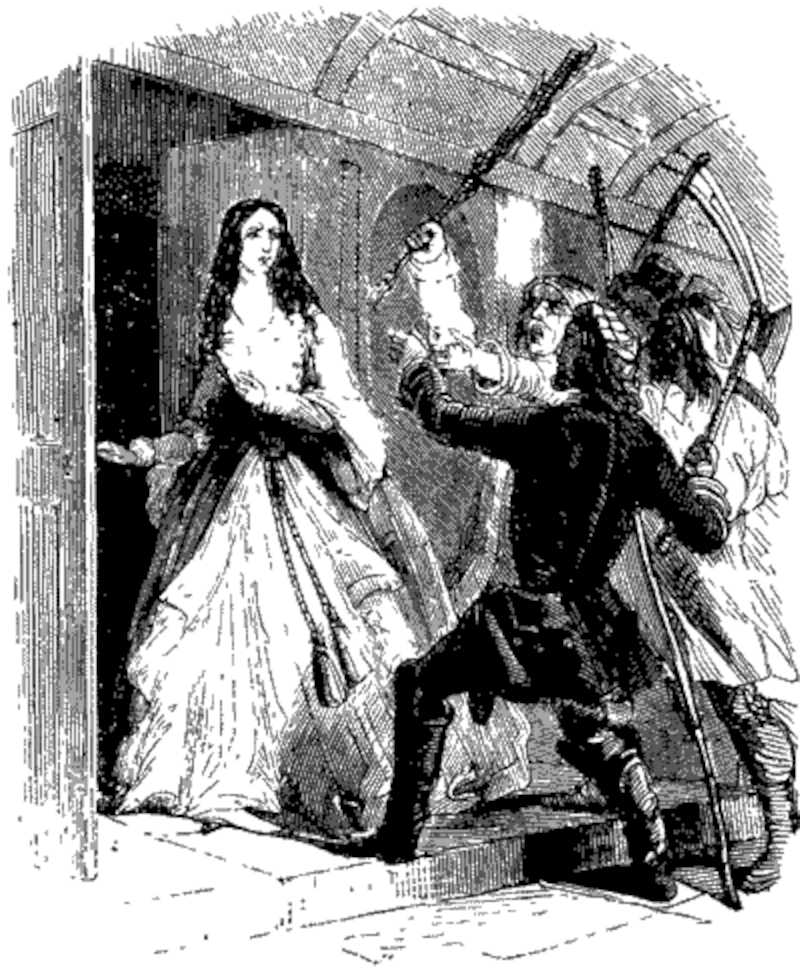
“Are you men, that you can come thus to force yourselves upon the privacy of a female? Is there nothing in the town or house, that you must intrude in numbers into a private apartment? Is no place sacred from you?”
“But, ma’am—miss—we only want Varney, the vampyre.”
“And can you find him nowhere but in a female’s bedroom? Shame on you! shame on you! Have you no sisters, wives, or mothers, that you act thus?”
“He’s not there, you may be sure of that, Jack,” said a gruff voice. “Let the lady be in quiet; she’s had quite enough trouble with him to sicken her of a vampyre. You may be sure that’s the last place to find him in.”
With this they all turned away, and Flora shut the door and locked it upon them, and Varney was safe.
“You have saved me,” said Varney.
“Hush!” said Flora. “Speak not; there maybe some one listening.”
Sir Francis Varney stood in the attitude of one listening most anxiously to catch some sounds; the moon fell across his face, and gave it a ghastly hue, that, added to his natural paleness and wounds, gave him an almost unearthly aspect.
The sounds grew more and more distant; the shouts and noise of men traversing the apartments subsided, and gradually the place became restored to its original silence. The mob, after having searched every other part of the house, and not finding the object of their search, they concluded that he was not there, but must have made his escape before.
This most desperate peril of Sir Francis Varney seemed to have more effect upon him than anything that had occurred during his most strange and most eventful career.
When he was assured that the riotous mob that had been so intent upon his destruction was gone, and that he might emerge from his place of concealment, he did so with an appearance of such utter exhaustion that the Bannerworth family could not but look upon him as a being who was near his end.
At any time his countenance, as we long have had occasion to remark, was a strange and unearthly looking one; but when we come to superadd to the strangeness of his ordinary appearance the traces of deep mental emotion, we may well say that Varney’s appearance was positively of the most alarming character.
When he was seated in the ordinary sitting apartment of the Bannerworths, he drew a long sighing breath, and placing his hand upon his heart, he said, in a faint tone of voice,—
“It beats now laboriously, but it will soon cease its pulsations for ever.”
These words sounded absolutely prophetic, there was about them such a solemn aspect, and he looked at the same time that he uttered them so much like one whose mortal race was run, and who was now a candidate for the grave.
“Do not speak so despairingly,” said Charles Holland; “remember, that if your life has been one of errors hitherto, how short a space of time may suffice to redeem some of them at least, and the communication to me which you have not yet completed may to some extent have such an effect.”
“No, no. It may contribute to an act of justice, but it can do no good to me. And yet do not suppose that because such is my impression that I mean to hesitate in finishing to you that communication.”
“I rejoice to hear you say so, and if you would, now that you must be aware of what good feelings towards you we are all animated with, remove the bar of secrecy from the communication, I should esteem it a great favour.”
Varney appeared to be considering for a few moments, and then he said,—
“Well, well. Let the secrecy no longer exist. Have it removed at once. I will no longer seek to maintain it. Tell all, Charles Holland—tell all.”
Thus empowered by the mysterious being, Charles Holland related briefly what Varney had already told him, and then concluded by saying,—
“That is all that I have myself as yet been made aware of, and I now call upon Sir Francis Varney to finish his narration.”
“I am weak,” said Varney, “and scarcely equal to the task; but yet I will not shrink from the promise that I have made. You have been the preservers of my life, and more particularly to you, Flora Bannerworth, am I indebted for an existence, which otherwise must have been sacrificed upon the altar of superstition.”
“But you will recollect, Master Varney,” said the admiral, who had sat looking on for some time in silent wonder, “you must recollect, Master Varney, that the people are, after all, not so much to blame for their superstition, because, whether you are a vampyre or not, and I don’t pretend to come to a positive opinion now, you took good care to persuade them you were.”
“I did,” said Varney, with a shudder; “but why did I?”
“Well, you know best.”
“It was, then, because I did believe, and do believe, that there is something more than natural about my strangely protracted existence; but we will waive that point, and, before my failing strength, for it appears to me to be failing, completely prevents me from doing so, let me relate to you the continued particulars of the circumstances that made me what I am.”
Previous Chapter Table of Contents Next Chapter
__________________________
1. Chapter LXXXVIII of the Project Gutenburg book of Varney the Vampire (Chapter LXXXVI in this copy) is close to 18,000 words long—that’s novella length. I have split this into three smaller chapters (LXXXV, LXXXVI, and LXXXVII) to facilitate more sensible reading.
2. The word singular can be used in several ways. In the context of the story, it indicates something that is unusual, odd, or peculiar. [Singular @ Merriam Webster]
__________________________