
Chapter LXXXVI
Sir Varney Shares His Story | Varney’s Failing Heath and Sickness
Flora Bannerworth, although she had heard before from the lips of Charles Holland the to her dreadful fact, that her father, in addition to having laid violent hands upon his own life, was a murderer, now that that fearful circumstance was related more publicly, felt a greater pang than she had done when it was whispered to her in the accents of pure affection, and softened down by a gentleness of tone, which Charles Holland’s natural delicacy would not allow him to use even to her whom he loved so well in the presence of others.
She let her beautiful face be hidden by her hands, and she wept as she listened to the sad detail.
Varney looked inquiringly in the countenance of Charles Holland, because, having given him leave to make Flora acquainted with the circumstance, he was rather surprised at the amount of emotion which it produced in her.
Charles Holland answered the appealing look by saying,—
“Flora is already aware of the facts, but it naturally affects her much to hear them now repeated in the presence of others, and those too, towards whom she cannot feel—”
What Charles Holland was going to say was abruptly stopped short by the admiral, who interposed, exclaiming,—
“Why, what do you mean, you son of a sea cook? The presence of who do you mean? Do you mean to say that I don’t feel for Miss Flora, bless her heart! quite as much as a white-faced looking swab like you? Why, I shall begin to think you are only fit for a marine.”
“Nay, uncle, now do not put yourself out of temper. You must be well aware that I could not mean anything disrespectful to you. You should not suppose such a state of things possible; and although, perhaps, I did not express myself so felicitously as I might, yet what I intended to say, was—”
“Oh, bother what you intended to say. You go on, Mr. Vampyre, with your story. I want to know what became of it all; just you get on as quick as you can, and let us know what you did after the man was murdered.”
“When the dreadful deed was committed,” said Varney, “and our victim lay weltering in his blood, and had breathed his last, we stood like men who for the first time were awakened to the frightful consequences of what they had done.
“I saw by the dim light that hovered round us a great change come over the countenance of Marmaduke Bannerworth, and he shook in every limb.
“This soon passed away, however, and the powerful and urgent necessity which arose of avoiding the consequences of the deed that we had done, restored us to ourselves. We stooped and took from the body the ill-gotten gains of the gambler. They amounted to an immense sum, and I said to Marmaduke Bannerworth,—
“‘Take you the whole of this money and proceed to your own home with it, where you will be least suspected. Hide it in some place of great secrecy, and to-morrow I will call upon you, when we will divide it, and will consider of some means of safely exchanging the notes for gold.’
“He agreed to this, and placed the money in his pocket, after which it became necessary that we should dispose of the body, which, if we did not quickly remove, must in a few hours be discovered, and so, perchance, accompanied by other criminating circumstances, become a frightful evidence against us, and entail upon us all those consequences of the deed which we were so truly anxious to escape from.
“It is ever the worst part of the murderer’s task, that after he has struck the blow that has deprived his victim of existence, it becomes his frightful duty to secrete the corpse, which, with its dead eyes, ever seems to be glaring upon him such a world of reproach.
“That it is which should make people pause ere they dipped their hands in the blood of others, and that it is which becomes the first retribution that the murderer has to endure for the deep crime that he has committed.
“We tore two stakes from a hedge, and with their assistance we contrived to dig a very superficial hole, such a hole as was only sufficient, by placing a thin coating of earth over it, to conceal the body of the murdered man.
“And then came the loathsome task of dragging him into it—a task full of horror, and from which we shrunk aghast; but it had to be done, and, therefore, we stooped, and grasping the clothes as best we might, we dragged the body into the chasm we had prepared for its reception. Glad were we then to be enabled to throw the earth upon it and to stamp upon it with such vehemence as might well be supposed to actuate men deeply anxious to put out of sight some dangerous and loathsome object.
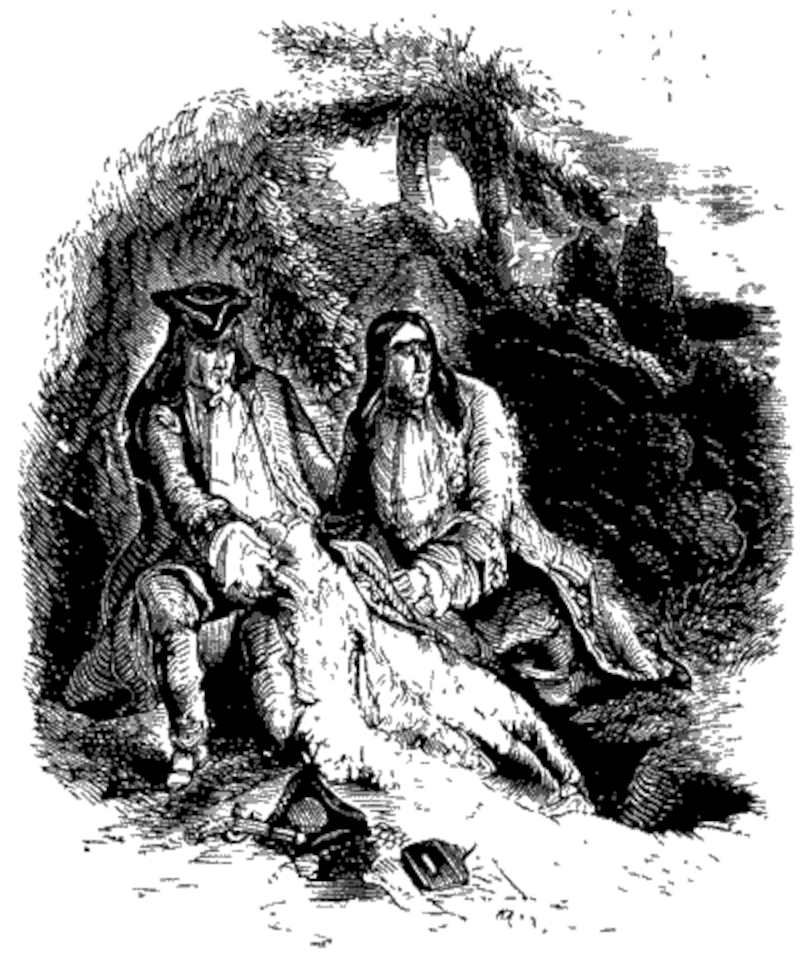
“When we had completed this, and likewise gathered handsfull of dust from the road, and dry leaves, and such other matter, to sprinkle upon the grave, so as to give the earth an appearance of not having been disturbed, we looked at each other and breathed from our toil.
“Then, and not till then, was it that we remembered that among other things which the gambler had won of Marmaduke were the deeds belonging to the Dearbrook property.”
“The Dearbrook property!” exclaimed Henry Bannerworth; “I know that there was a small estate going by that name, which belonged to our family, but I always understood that long ago my father had parted with it.”
“Yes; it was mortgaged for a small sum—a sum not a fourth part of its value—and it had been redeemed by Marmaduke Bannerworth, not for the purpose of keeping it, but in order that he might sell it outright, and so partially remedy his exhausted finances.”
“I was not aware of that,” returned Henry.
“Doubtless you were not, for of late—I mean for the twelve months or so preceding your father’s death—you know he was much estranged from all the family, so that you none of you knew much of what he was doing, except that he was carrying on a very wild and reckless career, such as was sure to end in dishonour and poverty; but I tell you he had the title deeds of the Dearbrook property, and that they were only got from him, along with everything else of value that he possessed, at the gaming-table, by the man who paid such a fearful penalty for his success.
“It was not until after the body was completely buried, and we had completed all our precautions for more effectually hiding it from observation, that we recollected the fact of those important papers being in his possession. It was Marmaduke Bannerworth who first remembered it, and he exclaimed,—
“‘By Heaven, we have buried the title deeds of the property, and we shall have again to exhume the corpse for the purpose of procuring them.’
“Now those deeds were nothing to me, and repugnant as I had felt from the first to having anything whatever to do with the dead body, it was not likely that I would again drag it from the earth for such an object.
“‘Marmaduke Bannerworth,’ I said, ‘you can do what you please, and take the consequences of what you do, but I will not again, if I can help it, look upon the face of that corpse. It is too fearful a sight to contemplate again. You have a large sum of money, and what need you care now for the title deeds of a property comparatively insignificant?’
“‘Well, well,’ he said, ‘I will not, at the present time, disturb the remains; I will wait to see if anything should arise from the fact of the murder; if it should turn out that no suspicion of any kind is excited, but that all is still and quiet, I can then take measures to exhume the corpse, and recover those papers, which certainly are important.’
“By this time the morning was creeping on apace, and we thought it prudent to leave the spot. We stood at the end of the lane for a few moments conversing, and those moments were the last in which I ever saw Marmaduke Bannerworth.”
“Answer me a question,” said Henry.
“I will; ask me what you please, I will answer it.”
“Was it you that called at Bannerworth Hall, after my father’s melancholy death, and inquired for him?”
“I did; and when I heard of the deed that he had done, I at once left, in order to hold counsel with myself as to what I should do to obtain at least a portion of the property, one-half of which, it was understood, was to have been mine. I heard what had been the last words used by Marmaduke Bannerworth on the occasion of his death, and they were amply sufficient to let me know what had been done with the money—at all events, so far as regards the bestowal of it in some secret place; and from that moment the idea of, by some means or another, getting the exclusive possession of it, never forsook my mind.
“I thought over the matter by day and, by night; and with the exception of having a knowledge of the actual hiding-place of the money, I could see, in the clearest possible manner, how the whole affair had been transacted. There can be no doubt but that Marmaduke Bannerworth had reached home safely with the large sum of which he had become possessed, and that he had hidden it securely, which was but an ordinary measure of precaution, when we come to consider how the property had been obtained.
“Then I suspect that, being alone, and left to the gloom of his own miserable thoughts, they reverted so painfully to the past that he was compelled to drink deeply for the purpose of drowning reflection.
“The natural consequence of this, in his state, was, that partial insanity supervened, and at a moment when frenzy rose far above reflection, he must have committed the dreadful act which hurried him instantaneously to eternity.”
“Yes,” said Henry; “it must have been so; you have guessed truly. He did on that occasion drink an immense quantity of wine; but instead of stilling the pangs of remorse it must have increased them, and placed him in such a frenzied condition of intellect, that he found it impossible to withstand the impulse of it, unless by the terrific act which ended his existence.”
“Yes, and which at once crushed all my expectations of the large fortune which was to have been mine; for even the one-half of the sum which had been taken from the gamester’s pocket would have been sufficient to have enabled me to live for the future in affluence.
“I became perfectly maddened at the idea that so large a sum had passed out of my hands. I constantly hovered about Bannerworth Hall, hoping and expecting that something might arise which would enable me to get admittance to it, and make an active search through its recesses for the hidden treasure.
“All my exertions were in vain. I could hit upon no scheme whatever; and at length, wearied and exhausted, I was compelled to proceed to London for the sake of a subsistence. It is only in that great metropolis that such persons as myself, destitute of real resources, but infinitely reckless as regards the means by which they acquire a subsistence, can hope to do so. Once again, therefore, I plunged into the vortex of London life, and proceeded, heedless of the criminality of what I was about, to cater for myself by robbery, or, indeed, in any manner which presented a prospect of success. It was during this career of mine, that I became associated with some of the most desperate characters of the time; and the offences we committed were of that daring character that it could not be wondered at eventually so formidable a gang of desperadoes must be by force broken up.
“It so occurred, but unknown to us, that the police resolved upon making one of the most vigorous efforts to put an end to the affair, and in consequence a watch was set upon every one of our movements.
“The result of this was, as might have been expected, our complete dispersion, and the arrest of some our members, and among them myself.
“I knew my fate almost from the first. Our depredations had created such a sensation, that the legislature, even, had made it a matter of importance that we should be suppressed, and it was an understood thing among the judges, that the severest penalties of the law should be inflicted upon any one of the gang who might be apprehended and convicted.
“My trial scarcely occupied an hour, and then I was convicted and sentenced to execution, with an intimation from the judge that it would be perfectly absurd of me to dream, for one moment, of a remission of that sentence.
“In this state of affairs, and seeing nothing but death before me, I gave myself up to despair, and narrowly missed cheating the hangman of his victim.
“More dead than alive, I was, however, dragged out to be judicially murdered, and I shall never forget the crowd of frightful sensations that came across my mind upon that terrific occasion.
“It seemed as if my fate had then reached its climax, and I have really but a dim recollection of the terrible scene.
“I remember something of the confused murmur arising from an immense throng of persons. I remember looking about me, and seeing nothing but what appeared to me an immense sea of human heads, and then suddenly I heard a loud roar of execration burst from the multitude.
“I shrunk back terrified, and it did, indeed, seem to me a brutal thing thus to roar and shout at a man who was brought out to die. I soon, however, found that the mob who came to see such a spectacle was not so debased as I imagined, but that it was at the hangman, who had suddenly made his appearance on the scaffold, at whom they raised that fearful yell.
“Some one—I think it was one of the sheriffs—must have noticed that I was labouring under the impression that the cry from the mob was levelled at me, for he spoke, saying,—
“‘It is at the hangman they shout,’ and he indicated with his finger that public functionary. In my mind’s eye I think I see him now, and I am certain that I shall never forget the expression of his face. It was perfectly fearful; and afterwards, when I learned who and what he was, I was not surprised that he should feel so acutely the painfully degrading office which he had to perform.
“The fatal rope was in a few minutes adjusted to my neck. I felt its pressure, and I heard the confused sounds of the monotonous voice of the clergyman, as he muttered some prayers, that I must confess sounded to me at the time like a mockery of human suffering.
“Then suddenly there was a loud shout—I felt the platform give way beneath my feet—I tried to utter a yell of agony, but could not—it seemed to me as if I was encompassed by fire, and then sensation left me, and I knew no more.
“The next feelings of existence that came over me consisted in a frightful tingling sensation throughout my veins, and I felt myself making vain efforts to scream. All the sensations of a person suffering from a severe attack of nightmare came across me, and I was in such an agony, that I inwardly prayed for death to release me from such a cruel state of suffering. Then suddenly the power to utter a sound came to me, and I made use of it well, for the piercing shriek I uttered, must have struck terror into the hearts of all who heard it, since it appalled even myself.
“Then I suppose I must have fainted, but when I recovered consciousness again, I found myself upon a couch, and a man presenting some stimulus to me in a cup. I could not distinguish objects distinctly, but I heard him say, ‘Drink, and you will be better.’
“I did drink, for a raging thirst consumed me, and then I fell into a sound sleep, which, I was afterwards told, lasted nearly twenty-four hours, and when I recovered from that, I heard again the same voice that had before spoken to me, asking me how I was.
“I turned in the direction of the sound, and, as my vision was now clearer, I could see that it was the hangman, whose face had made upon the scaffold such an impression upon me—an impression which I then considered my last in this world, but which turned out not to be such by many a mingled one of pain and pleasure since.
“It was some time before I could speak, and when I did, it was only in a few muttered words, to ask what had happened, and where I was.
“‘Do you not remember,’ he said, ‘that you were hanged?’
“‘I do—I do,’ was my reply. ‘Is this the region of damned souls?’
“‘No; you are still in this world, however strange you may think it. Listen to me, and I will briefly tell you how it is that you have come back again, as it were, from the very grave, to live and walk about among the living.”
“I listened to him with a strange and rapt attention, and then he told how a young and enthusiastic medical man had been anxious to try some experiments with regard to the restoration of persons apparently dead, and he proceeded to relate how it was that he had given ear to the solicitations of the man, and had consented to bring my body after it was hung for him to experiment upon. He related how the doctor had been successful, but how he was so terrified at his own success, that he hastily fled, and had left London, no one knowing whither he had gone.
“I listened to this with the most profound attention, and then he concluded, by saying to me,—
“‘There can be no doubt but my duty requires of me to give you up again to the offended laws of your country. I will not, however, do that, if you will consent to an arrangement that I shall propose to you.’
“I asked him what the arrangement was, and he said that if I would solemnly bind myself to pay to him a certain sum per annum, he would keep my secret, and forsaking his calling as hangman, endeavour to do something that should bring with it pleasanter results. I did so solemnly promise him, and I have kept my word. By one means or another I have succeeded in procuring the required amount, and now he is no more.”
“I believe,” cried Henry, “that he has fallen a victim to the blind fury of the populace.”
“You are right, he has so, and accordingly I am relieved from the burden of those payments; but it matters little, for now I am so near the tomb myself, that, together with all my obligations, I shall soon be beyond the reach of mortal cavilling.”
“You need not think so, Varney; you must remember that you are at present suffering from circumstances, the pressure of which will soon pass away, and then you will resume your wonted habits.”
“What did you do next?” said the admiral.—”Let’s know all while you are about it.”
“I remained at the hangman’s house for some time, until all fear of discovery was over, and then he removed me to a place of greater security, providing me from his own resources with the means of existence, until I had fully recovered my health, and then he told me to shift for myself.
“During my confinement though, I had not been idle mentally, for I concocted a plan, by which I should be enabled not only to live well myself, but to pay to the hangman, whose name was Mortimore, the annual sum I had agreed upon. I need not go into the details of this plan. Of course it was neither an honest nor respectable one, but it succeeded, and I soon found myself in a position to enable me thereby to keep my engagement, as well as to supply me with means of plotting and planning for my future fortunes.
“I had never for a moment forgotten that so large a sum of money was somewhere concealed about Bannerworth Hall, and I still looked forward to obtaining it by some means or another.
“It was in this juncture of affairs, that one night I was riding on horseback through a desolate part of England. The moon was shining sweetly, as I came to a broad stream of water, across which, about a mile further on, I saw that there was a bridge, but being unwilling to waste time by riding up to it, and fancying, by the lazy ripple of the waters, that the river was not shallow, I plunged my horse boldly into the stream.
“When we reached its centre, some sudden indisposition must have seized the horse, for instead of swimming on well and gallantly as it had done before, it paused for a moment, and then plunged headlong into the torrent.
“I could not swim, and so, for a second time, death, with all its terrors, appeared to be taking possession of me. The waters rolled over my head, gurgling and hissing in my ears, and then all was past. I know no more, until I found myself lying upon a bright green meadow, and the full beams of the moon shining upon me.
“I was giddy and sick, but I rose, and walked slowly away, each moment gathering fresh strength, and from that time to this, I never discovered how I came to be rescued from the water, and lying upon that green bank. It has ever been a mystery to me, and I expect it ever will.
“Then from that moment the idea that I had a sort of charmed life came across me, and I walked about with an impression that such was the case, until I came across a man who said that he was a Hungarian, and who was full of strange stories of vampyres. Among other things, he told me that a vampyre could not be drowned, for that the waters would cast him upon its banks, and, if the moonbeams fell upon him, he would be restored to life.
“This was precisely my story, and from that moment I believed myself to be one of those horrible, but charmed beings, doomed to such a protracted existence. The notion grew upon me day by day, and hour by hour, until it became quite a fixed and strong belief, and I was deceiving no one when I played the horrible part that has been attributed to me.”
“But you don’t mean to say that you believe you are a vampyre now?” said the admiral.
“I say nothing, and know not what to think. I am a desperate man, and what there is at all human in me, strange to say, all of you whom I sought to injure, have awakened.”
“Heed not that,” said Henry, “but continue your narrative. We have forgiven everything, and that ought to suffice to quiet your mind upon such a subject.”
“I will continue; and, believe me, I will conceal nothing from you. I look upon the words I am now uttering as a full, candid, and free confession; and, therefore, it shall be complete.
“The idea struck me that if, by taking advantage of my supposed preternatural gifts, I could drive you from Bannerworth Hall, I should have it to myself to hunt through at my leisure, and possibly find the treasure. I had heard from Marmaduke Bannerworth some slight allusion to concealing the money behind a picture that was in a bed-room called the panelled chamber. By inquiry, I ascertained that in that bed-room slept Flora Bannerworth.
“I had resolved, however, at first to try pacific measures, and accordingly, as you are well aware, I made various proposals to you to purchase or to rent Bannerworth Hall, the whole of which you rejected; so that I found myself compelled to adopt the original means that had suggested themselves to me, and endeavour to terrify you from the house.
“By prowling about, I made myself familiar with the grounds, and with all the plan of the residence, and then one night made my appearance in Flora’s chamber by the window.”
“But how do you account,” said Charles Holland, “for your extraordinary likeness to the portrait?”
“It is partly natural, for I belong to a collateral branch of the family; and it was previously arranged. I had seen the portrait in Marmaduke Bannerworth’s time, and I knew some of its peculiarities and dress sufficiently well to imitate them. I calculated upon producing a much greater effect by such an imitation; and it appears that I was not wrong, for I did produce it to the full.”
“You did, indeed,” said Henry; “and if you did not bring conviction to our minds that you were what you represented yourself to be, you at least staggered our judgments upon the occasion, and left us in a position of great doubt and difficulty.”
“I did; I did all that, I know I did; and, by pursuing that line of conduct, I, at last, I presume, entirely forced you from the house.”
“That you did.”
“Flora fainted when I entered her chamber; and the moment I looked upon her sweet countenance my heart smote me for what I was about; but I solemnly aver, that my lips never touched her, and that, beyond the fright, she suffered nothing from Varney, the vampyre.”
“And have you succeeded,” said Henry, “in your object now?”
“No; the treasure has yet to be found. Mortimore, the hangman, followed me into the house, guessing my intention, and indulging a hope that he would succeed in sharing with me its proceeds. But he, as well as myself, was foiled, and nothing came of the toilsome and anxious search but disappointment and bitterness.”
“Then it is supposed that the money is still concealed?”
“I hope so; I hope, as well, that it will be discovered by you and yours; for surely none can have a better right to it than you, who have suffered so much on its account.”
“And yet,” remarked Henry, “I cannot help thinking it is too securely hidden from us. The picture has been repeatedly removed from its place, and produced no results; so that I fear we have little to expect from any further or more protracted research.”
“I think,” said Varney, “that you have everything to expect. The words of the dying Marmaduke Bannerworth, you may depend, were not spoken in vain; and I have every reason to believe that, sooner or later, you must, without question, become the possessors of that sum.”
“But ought we rightly to hold it?”
“Who ought more rightly to hold it?” said Varney; “answer me that.”
“That’s a sensible enough idea of your’s,” said the admiral; “and if you were twice over a vampyre, I would tell you so. It’s a very sensible idea; I should like to know who has more right to it than those who have had such a world of trouble about it.”
“Well, well,” said Henry, “we must not dispute, as yet, about a sum of money that may really never come to hand. For my own part, I have little to hope for in the matter; but, certainly, nothing shall be spared, on my part, to effect such a thorough search of the Hall as shall certainly bring it to light, if it be in existence.”
“I presume, Sir Francis Varney,” said Charles Holland, “that you have now completed your narrative?”
“I have. After events are well known to you. And, now, I have but to lie down and die, with the hope of finding that rest and consolation in the tomb which has been denied me hitherto in this world. My life has been a stormy one, and full of the results of angry passions. I do hope now, that, for the short time I have to live, I shall know something like serenity, and die in peace.”
“You may depend, Varney, that, as long as you have an asylum with us,” said the admiral—”and that you may have as long as you like,—you may be at peace. I consider that you have surrendered at discretion, and, under such circumstances, an enemy always deserves honourable treatment, and always gets it on board such a ship as this.”
“There you go again,” said Jack, “calling the house a ship.”
“What’s that to you, if I were to call it a bowsprit? Ain’t I your captain, you lubber, and so, sure to be right, while you are wrong, in the natural order of things? But you go and lay down, Master Varney, and rest yourself, for you seem completely done up.”
Varney did look fearfully exhausted; and, with the assistance of Henry and Charles, he went into another apartment, and laid down upon a couch, showing great symptoms of debility and want of power.
And now it was a calm; Varney’s stay at the cottage of the Bannerworths was productive of a different mood of mind than ever he had possessed before. He looked upon them in a very different manner to what he had been used to. He had, moreover, considerably altered prospects; there could not be the same hopes and expectations that he once had. He was an altered man. He saw in the Bannerworths those who had saved his life, and who, without doubt, had possessed an opinion, not merely obnoxious to him, but must have had some fearful misgivings concerning his character, and that, too, of a nature that usually shuts out all hope of being received into any family.
But, in the hour of his need, when his life was in danger, no one else would have done what they had done for him, especially when so relatively placed.
Moreover, he had been concealed, when to do so was both dangerous and difficult; and then it was done by Flora Bannerworth herself.
Time flew by. The mode of passing time at the cottage was calm and serene. Varney had seldom witnessed anything like it; but, at the same time, he felt more at ease than ever he had; he was charmed with the society of Flora—in fact, with the whole of the little knot of individuals who there collected together; from what he saw he was gratified in their society; and it seemed to alleviate his mental disquiet, and the sense he must feel of his own peculiar position. But Varney became ill. The state of mind and body he had been in for some time past might be the cause of it. He had been much harassed, and hunted from place to place. There was not a moment in which his life was not in danger, and he had, moreover, more than one case, received some bodily injuries, bruises, and contusions of a desperate character; and yet he would take no notice of them, but allow them to get well again, as best they could.
His escapes and injuries had made a deep impression upon his mind, and had no doubt a corresponding effect upon his body, and Varney became very ill.
Flora Bannerworth did all that could be done for one in his painful position, and this greatly added to the depths of thought that occasionally beset him, and he could scarcely draw one limb after the other.
He walked from room to room in the twilight, at which time he had more liberty permitted him than at any other, because there was not the same danger in his doing so; for, if once seen, there could be no manner of doubt but he would have been pursued until he was destroyed, when no other means of escape were at hand; and Varney himself felt that there could be no chance of his again escaping from them, for his physical powers were fast decaying; he was not, in fact, the same man.
He came out into the parlour from the room in which he had been seated during the day. Flora and her mother were there, while Charles Holland and Henry Bannerworth had both at that moment entered the apartment.
“Good evening, Miss Bannerworth,” said Sir Francis, bowing to her, and then to her mother, Mrs. Bannerworth; “and you, Mr. Holland, I see, have been out enjoying the free breeze that plays over the hot fields. It must be refreshing.”
“It is so, sir,” said Charles. “I wish we could make you a partaker in our walks.”
“I wish you could with all my heart,” said Varney.
“Sir Francis,” said Flora, “must be a prisoner for some short time longer yet.”
“I ought not to consider it in any such light. It is not imprisonment. I have taken sanctuary. It is the well spring of life to me,” said Varney.
“I hope it may prove so; but how do you find yourself this evening, Sir Francis Varney?”
“Really, it is difficult to say—I fluctuate. At times, I feel as though I should drop insensible on the earth, and then I feel better than I have done for some time previously.”
“Doctor Chillingworth will be here bye and bye, no doubt; and he must see what he can do for you to relieve you of these symptoms,” said Flora.
“I am much beholden to you—much beholden to you; but I hope to be able to do without the good doctor’s aid in this instance, though I must admit I may appear ungrateful.”
“Not at all—not at all.”
“Have you heard any news abroad to-day?” inquired Varney.
“None, Sir Francis—none; there is nothing apparently stirring; and now, go out when you would, you would find nothing but what was old, quiet, and familiar.”
“We cannot wish to look upon anything with mere charms for a mind at ease, than we can see under such circumstances; but I fear there are some few old and familiar features that I should find sad havoc in.”
“You would, certainly, for the burnings and razings to the ground of some places, have made some dismal appearances; but time may efface that, and then the evil may die away, and the future will become the present, should we be able to allay popular feeling.”
“Yes,” said Sir Francis; “but popular prejudices, or justice, or feeling, are things not easily assuaged. The people when once aroused go on to commit all kinds of excess, and there is no one point at which they will step short of the complete extirpation of some one object or other that they have taken a fancy to hunt.”
“The hubbub and excitement must subside.”
“The greater the ignorance the more persevering and the more brutal they are,” said Sir Francis; “but I must not complain of what is the necessary consequence of their state.”
“It might be otherwise.”
“So it might, and no mischief arise either; but as we cannot divert the stream, we may as well bend to the force of a current too strong to resist.”
“The moon is up,” said Flora, who wished to turn the conversation from that to another topic. “I see it yonder through the trees; it rises red and large—it is very beautiful—and yet there is not a cloud about to give it the colour and appearance it now wears.”
“Exactly so,” said Sir Francis Varney; “but the reason is the air is filled with a light, invisible vapour, that has the effect you perceive. There has been much evaporation going on, and now it shows itself in giving the moon that peculiar large appearance and deep colour.”
“Ay, I see; it peeps through the trees, the branches of which cut it up into various portions. It is singular, and yet beautiful, and yet the earth below seems dark.”
“It is dark; you would be surprised to find it so if you walked about. It will soon be lighter than it is at this present moment.”
“What sounds are those?” inquired Sir Francis Varney, as he listened attentively.
“Sounds! What sounds?” returned Henry.
“The sounds of wheels and horses’ feet,” said Varney.
“I cannot even hear them, much less can I tell what they are,” said Henry.
“Then listen. Now they come along the road. Cannot you hear them now?” said Varney.
“Yes, I can,” said Charles Holland; “but I really don’t know what they are, or what it can matter to us; we don’t expect any visitors.”
“Certainly, certainly,” said Varney. “I am somewhat apprehensive of the approach of strange sounds.”
“You are not likely to be disturbed here,” said Charles.
“Indeed; I thought so when I had succeeded in getting into the house near the town, and so far from believing it was likely I should be discovered, that I sat on the house-top while the mob surrounded it.”
“Did you not hear them coming?”
“I did.”
“And yet you did not attempt to escape from them?”
“No, I could not persuade them I was not there save by my utter silence. I allowed them to come too close to leave myself time to escape—besides, I could hardly persuade myself there could be any necessity for so doing.”
“It was fortunate it was as it happened afterwards, that you were able to reach the wood, and get out of it unperceived by the mob.”
“I should have been in an unfortunate condition had I been in their hands long. A man made of iron would not be able to resist the brutality of those people.”
As they were speaking, a gig, with two men, drove up, followed by one on horseback. They stopped at the garden-gate, and then tarried to consult with each other, as they looked at the house.
Previous Chapter Table of Contents Next Chapter
__________________________