
Chapter LXXXVII
Varney’s Encounter with the Bow-Street Runners | The Quest for the Missing Deeds
“What can they want, I wonder?” inquired Henry; “I never saw them before.”
“Nor I,” said Charles Holland.
“Do you not know them at all?” inquired Varney.
“No,” replied Flora; “I never saw them, neither can I imagine what is their object in coming here.”
“Did you ever see them before?” inquired Henry of his mother, who held up her hand to look more carefully at the strangers; then, shaking her head, she declared she had never seen such persons as those.
“I dare say not,” said Charles Holland. “They certainly are not gentlemen; but here they come; there is some mistake, I daresay—they don’t want to come here.”
As they spoke, the two strangers got down; after picking up a topcoat they had let fall, they turned round, and deliberately put it into the chaise again; they walked up the path to the door, at which they knocked.
The door was opened by the old woman, when the two men entered.
“Does Francis Beauchamp live here?”
“Eh?” said the old woman, who was a little deaf, and she put her hand behind her ear to catch the sounds more distinctly—”eh?—who did you say?”
Sir Francis Varney started as the sounds came upon his ear, but he sat still an attentive listener.
“Are there any strangers in the house?” inquired the other officer, impatiently. “Who is here?”
“Strangers!” said the old woman; “you are the only strangers that I have seen here.”
“Come,” said the officer to his companion, “come this way; there are people in this parlour. Our business must be an apology for any rudeness we may commit.”
As he spoke he stepped by the old woman, and laying his hand upon the handle of the door, entered the apartment, at the same time looking carefully around the room as if he expected some one.
“Ladies,” said the stranger, with an off-hand politeness that had something repulsive in it, though it was meant to convey a notion that civility was intended; “ladies, I beg pardon for intruding, but I am looking for a gentleman.”
“You shall hear from me again soon,” said Sir Francis, in an almost imperceptible whisper.
“What is the object of this intrusion?” demanded Henry Bannerworth, rising and confronting the stranger. “This is a strange introduction.”
“Yes, but not an unusual one,” said the stranger, “in these cases—being unavoidable, at the least.”
“Sir,” said Charles Holland, “if you cannot explain quickly your business here, we will proceed to take those measures which will at least rid ourselves of your company.”
“Softly, sir. I mean no offence—not the least; but I tell you I do not come for any purpose that is at all consonant to my wishes. I am a Bow-street officer in the execution of my duty—excuse me, therefore.”
“Whom do you want?”
“Francis Beauchamp; and, from the peculiarity of the appearance of this individual here, I think I may safely request the pleasure of his company.”
Varney now rose, and the officer made a rush at him, when he saw him do so, saying,—
“Surrender in the king’s name.”
Varney, however, paid no attention to that, but rushed past, throwing his chair down to impede the officer, who could not stay himself, but fell over it, while Varney made a rush towards the window, which he cleared at one bound, and crossing the road, was lost to sight in a few seconds, in the trees and hedges on the other side.
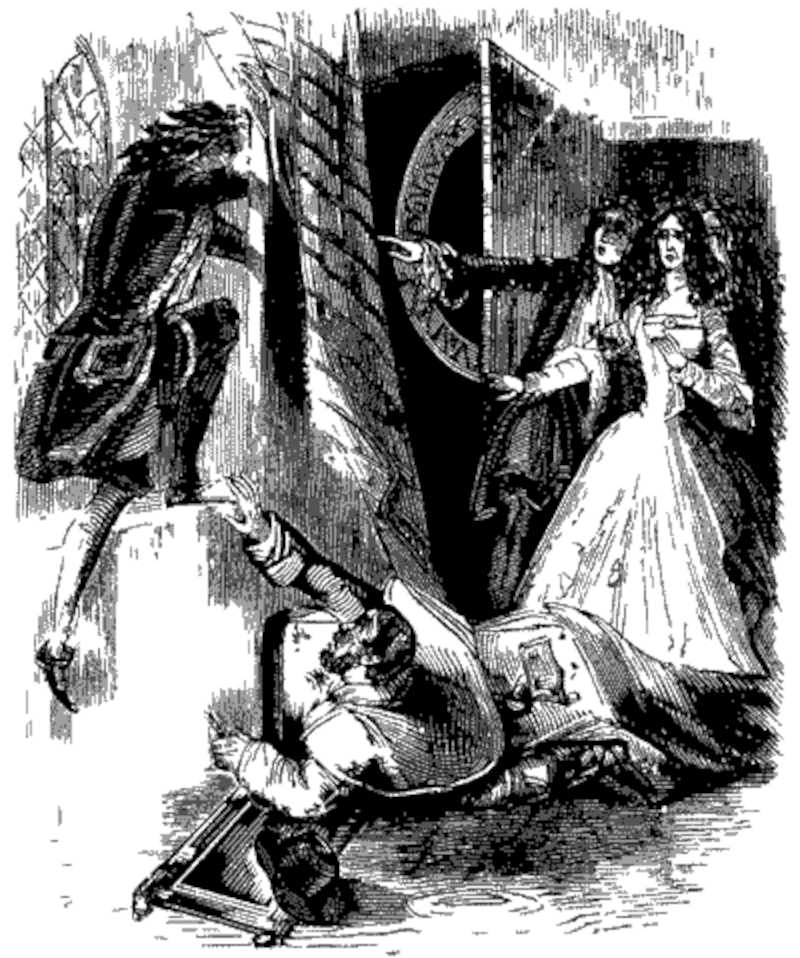
“Accidents will happen,” said the officer, as he rose to his feet; “I did not think the fellow would have taken the window in that manner; but we have him in view, and that will be enough.”
“In heaven’s name,” said Henry, “explain all about this; we cannot understand one word of it—I am at a loss to understand one word of it.”
“We will return and do so presently,” said the officer as he dashed out of the house after the fugitive at a rapid and reckless speed, followed by his companion.
The man who had been left with the chaise, however, was the first in the chase; seeing an escape from the window, he immediately guessed that he was the man wanted, and, but for an accident, he would have met Varney at the gate, for, as he was getting out in a hurry, his foot became entangled with the reins, and he fell to the ground, and Varney at the same moment stepped over him.
“Curse his infernal impudence, and d—n these reins!” muttered the man in a fury at the accident, and the aggravating circumstance of the fugitive walking over him in such a manner, and so coolly too—it was vexing.
The man, however, quickly released himself, and rushed after Varney across the road, and kept on his track for some time. The moon was still rising, and shed but a gloomy light around. Everything was almost invisible until you came close to it. This was the reason why Varney and his pursuer met with several severe accidents—fumbles and hard knocks against impediments which the light and the rapid flight they were taking did not admit of their avoiding very well.
They went on for some time, but it was evident Varney knew the place best, and could avoid what the man could not, and that was the trees and the natural impediments of the ground, which Varney was acquainted with.
For instance, at full speed across a meadow, a hollow would suddenly present itself, and to an accustomed eye the moonlight might enable it to be distinguished at a glance what it was, while to one wholly unaccustomed to it, the hollow would often look like a hillock by such a light. This Varney would clear at a bound, which a less agile and heavier person would step into, lifting up his leg to meet an impediment, when he would find it come down suddenly some six or eight inches lower than he anticipated, almost dislocating his leg and neck, and producing a corresponding loss of breath, which was not regained by the muttered curse upon such a country where the places were so uneven.
Having come to one of these places, which was a little more perceptible than the others, he made a desperate jump, but he jumped into the middle of the hole with such force that he sprained his ankle, besides sinking into a small pond that was almost dry, being overgrown with rushes and aquatic plants.
“Well?” said the other officer coming up—”well?”
“Well, indeed!” said the one who came first; “it’s anything but well. D—n all country excursions say I.”
“Why, Bob, you don’t mean to say as how you are caught in a rat-trap?”
“Oh, you be d——d! I am, ain’t I?”
“Yes; but are you going to stop there, or coming out, eh? You’ll catch cold.”
“I have sprained my ankle.”
“Well?”
“It ain’t well, I tell you; here have I a sprained foot, and my wind broken for a month at least. Why were you not quicker? If you had been sharper we should have had the gentleman, I’ll swear!”
“I tumbled down over the chair, and he got out of the window, and I come out of the door.”
“Well, I got entangled in the reins; but I got off after him, only his long legs carried him over everything. I tell you what, Wilkinson, if I were to be born again, and intended to be a runner, I would bespeak a pair of long legs.”
“Why?”
“Because I should be able to get along better. You have no idea of how he skimmed along the ground; it was quite beautiful, only it wasn’t good to follow it.”
“A regular sky scraper!”
“Yes, or something of that sort; he looked like a patent[1] flying shadow.”
“Well, get up and lead the way; we’ll follow you.”
“I dare say you will—when I lead the way back there; for as to going out yonder, it is quite out of the question. I want supper to-night and breakfast to-morrow morning.”
“Well, what has that to do with it?”
“Just this much: if you follow any farther, you’ll get into the woods, and there you’ll be, going round and round, like a squirrel in a cage, without being able to get out, and you will there get none of the good things included under the head of those meals.”
“I think so too,” said the third.
“Well, then, let’s go back; we needn’t run, though it might be as well to do so.”
“It would be anything but well. I don’t gallop back, depend upon it.”
The three men now slowly returned from their useless chase, and re-trod the way they had passed once in such a hurry that they could hardly recognize it.
“What a dreadful bump I came against that pole standing there,” said one.
“Yes, and I came against a hedge-stake, that was placed so as the moon didn’t show any light on it. It came into the pit of my stomach. I never recollect such a pain in my life; for all the world like a hot coal being suddenly and forcibly intruded into your stomach.”
“Well, here’s the road. I must go up to the house where I started him from. I promised them some explanation. I may as well go and give it to them at once.”
“Do as you will. I will wait with the horse, else, perhaps, that Beauchamp will again return and steal him.”
The officer who had first entered the house now returned to the Bannerworths, saying,
“I promised you I would give you some explanation as to what you have witnessed.”
“Yes,” said Henry; “we have been awaiting your return with some anxiety and curiosity. What is the meaning of all this? I am, as we are all, in perfect ignorance of the meaning of what took place.”
“I will tell you. The person whom you have had here, and goes by the name of Varney, is named Francis Beauchamp.”
“Indeed! Are you assured of this?”
“Yes, perfectly assured of it; I have it in my warrant to apprehend him by either name.”
“What crime had he been guilty of?”
“I will tell you: he has been hanged.”
“Hanged!” exclaimed all present.
“What do you mean by that?” added Henry; “I am at a loss to understand what you can mean by saying he was hanged.”
“What I say is literally true.”
“Pray tell us all about it. We are much interested in the fact; go on, sir.”
“Well, sir, then I believe it was for murder that Francis Beauchamp was hanged—yes, hanged; a common execution, before a multitude of people, collected to witness such an exhibition.”
“Good God!” exclaimed Henry Bannerworth. “And was—but that is impossible. A dead man come to life again! You must be amusing yourself at our expense.”
“Not I,” replied the officer. “Here is my warrant; they don’t make these out in a joke.”
And, as he spoke, he produced the warrant, when it was evident the officer spoke the truth.
“How was this?”
“I will tell you, sir. You see that this Varney was a regular scamp, gamester, rogue, and murderer. He was hanged, and hung about the usual time; he was cut down and the body was given to some one for dissection, when a surgeon, with the hangman, one Montgomery, succeeded in restoring the criminal to life.”
“But I always thought they broke the neck when they were hanged; the weight of the body would alone do that.”
“Oh, dear, no, sir,” said the officer; “that is one of the common every day mistakes; they don’t break the neck once in twenty times.”
“Indeed!”
“No; they die of suffocation only; this man, Beauchamp, was hanged thus, but they contrived to restore him, and then he assumed a new name, and left London.”
“But how came you to know all this?”
“Oh! it came to us, as many things usually do, in a very extraordinary manner, and in a manner that appears most singular and out of the way; but such it was.
“The executioner who was the means of his being restored, or one of them, wished to turn him to account, and used to draw a yearly sum of money from him, as hush money, to induce them to keep the secret; else, the fact of his having escaped punishment would subject him to a repetition of the same punishment; when, of course, a little more care would be taken that he did not escape a second time.”
“I dare say not.”
“Well, you see, Varney, or rather Beauchamp, was to pay a heavy sum to this man to keep him quiet, and to permit him to enjoy the life he had so strangely become possessed of.”
“I see,” said Holland.
“Well, this man, Montgomery, had always some kind of suspicion that Varney would murder him.”
“Murder him! and be the means of saving his life; surely he could not be so bad as that.”
“Why, you see, sir, this hangman drew a heavy sum yearly from him; thus making him only a mine of wealth to himself; this, no doubt, would rankle in the other’s heart, to think he should be so beset, and hold life upon such terms.”
“I see, now.”
“Yes; and then came the consideration that he did not do it from any good motive, merely a selfish one, and he was consequently under no obligation to him for what he had done; besides, self-preservation might urge him on, and tell him to do the deed.
“However that may be, Montgomery dreaded it, and was resolved to punish the deed if he could not prevent it. He, therefore, left general orders with his wife, whenever he went on a journey to Varney, if he should be gone beyond a certain time, she was to open a certain drawer, and take out a sealed packet to the magistrate at the chief office, who would attend to it.
“He has been missing, and his wife did as she was desired, and now we have found what he there mentioned to be true; but, now, sir, I have satisfied you and explained to you why we intruded upon you, we must now leave and seek for him elsewhere.”
“It is most extraordinary, and that is the reason why his complexion is so singular.”[2]
“Very likely.”
They poured out some wine, which was handed to the officers, who drank and then quitted the house, leaving the inmates in a state of stupefaction, from surprise and amazement at what they had heard from the officers.
There was a strange feeling came over them when they recollected the many occurrences they had witnessed, and even the explanation of the officers; it seemed as if some mist had enveloped objects and rendered them indistinct, but which was fast rising, and they were becoming plainer and more distinct every moment in which they were regarded.
There was a long pause, and Flora was about to speak, when suddenly there came the sound of a footstep across the garden. It was slow but unsteady, and paused between whiles until it came close beneath the windows. They remained silent, and then some one was heard to climb up the rails of the veranda, and then the curtains were thrust aside, but not till after the person outside had paused to ascertain who was there.
Then the curtains were opened, and the visage of Sir Francis Varney appeared, much altered; in fact, completely worn and exhausted.
It was useless to deny it, but he looked ghastly—terrific;[3] his singular visage was as pallid as death; his eyes almost protruding, his mouth opened, and his breathing short, and laboured in the extreme.
He climbed over with much difficulty, and staggered into the room, and would have spoken, but he could not; befell senseless upon the floor, utterly exhausted and motionless.
There was a long pause, and each one present looked at each other, and then they gazed upon the inanimate body of Sir Francis Varney, which lay supine and senseless in the middle of the floor.
* * *[4]
The importance of the document, said to be on the dead body, was such that it would admit of no delay before it was obtained, and the party determined that it should be commenced instanter. Lost time would be an object to them; too much haste could hardly be made; and now came the question of, “should it be to-night, or not?”
“Certainly,” said Henry Bannerworth; “the sooner we can get it, the sooner all doubt and distress will be at an end; and, considering the turn of events, that will be desirable for all our sakes; besides, we know not what unlucky accident may happen to deprive us of what is so necessary.”
“There can be none,” said Mr. Chillingworth; “but there is this to be said, this has been such an eventful history, that I cannot say what might or what might not happen.”
“We may as well go this very night,” said Charles Holland. “I give my vote for an immediate exhumation of the body. The night is somewhat stormy, but nothing more; the moon is up, and there will be plenty of light.”
“And rain,” said the doctor.
“Little or none,” said Charles Holland. “A few gusts of wind now and then drive a few heavy plashes of rain against the windows, and that gives a fearful sound, which is, in fret, nothing, when you have to encounter it; but you will go, doctor?”
“Yes, most certainly. We must have some tools.”
“Those may be had from the garden,” said Henry. “Tools for the exhumation, you mean?”
“Yes; pickaxe, mattocks, and a crowbar; a lantern, and so forth,” said the doctor. “You see I am at home in this; the fact is, I have had more than one affair of this kind on my hands before now, and whilst a student I have had more than one adventure of a strange character.”
“I dare say, doctor,” said Charles Holland, “you have some sad pranks to answer for; you don’t think of it then, only when you find them accumulated in a heap, so that you shall not be able to escape them; because they come over your senses when you sleep at night.”
“No, no,” said Chillingworth; “you are mistaken in that. I have long since settled all my accounts of that nature; besides, I never took a dead body out of a grave but in the name of science, and never for my own profit, seeing I never sold one in my life, or got anything by it.”
“That is not the fact,” said Henry; “you know, doctor, you improved your own talents and knowledge.”
“Yes, yes; I did.”
“Well, but you profited by such improvements?”
“Well, granted, I did. How much more did the public not benefit then,” said the doctor, with a smile.
“Ah, well, we won’t argue the question,” said Charles; “only it strikes me that the doctor could never have been a doctor if he had not determined upon following a profession.”
“There may be a little truth in that,” said Chillingworth; “but now we had better quit the house, and make the best of our way to the spot where the unfortunate man lies buried in his unhallowed grave.”
“Come with me into the garden,” said Henry Bannerworth; “we shall there be able to suit ourselves to what is required. I have a couple of lanterns.”
“One is enough,” said Chillingworth; “we had better not burden ourselves more than we are obliged to do; and we shall find enough to do with the tools.”
“Yes, they are not light; and the distance is by far too great to make walking agreeable and easy; the wind blows strong, and the rain appears to be coming up afresh, and, by the time we have done, we shall find the ground will become slippy, and bad for walking.”
“Can we have a conveyance?”
“No, no,” said the doctor; “we could, but we must trouble the turnpike man; besides, there is a shorter way across some fields, which will be better and safer.”
“Well, well,” said Charles Holland; “I do not mind which way it is, as long as you are satisfied yourselves. The horse and cart would have settled it all better, and done it quicker, besides carrying the tools.”
“Very true, very true,” said the doctor; “all that is not without its weight, and you shall choose which way you would have it done; for my part, I am persuaded the expedition on foot is to be preferred for two reasons.”
“And what are they?”
“The first is, we cannot obtain a horse and cart without giving some detail as to what you want it for, which is awkward, on account of the hour. Moreover, you could not get one at this moment in time.”
“That ought to settle the argument,” said Henry Bannerworth; “an impossibility, under the circumstances, at once is a clincher, and one that may be allowed to have some weight.”
“You may say that,” said Charles.
“Besides which, you must go a greater distance, and that, too, along the main road, which is objectionable.”
“Then we are agreed,” said Charles Holland, “and the sooner we are off the better; the night grows more and more gloomy every hour, and more inclement.”
“It will serve our purpose the better,” said Chillingworth. “What we do, we may as well do now.”
“Come with me to the garden,” said Henry, “and we will take the tools. We can go out the back way; that will preclude any observation being made.”
They all now left the apartment, wrapped up in great overcoats, to secure themselves against the weather, and also for the purpose of concealing themselves from any chance passenger.
In the garden they found the tools they required, and having chosen them, they took a lantern, with the mean of getting a light when they got to their journey’s end, which they would do in less than an hour.
After having duly inspected the state of their efficiency, they started away on their expedition.
The night had turned gloomy and windy; heavy driving masses of clouds obscured the moon, which only now and then was to be seen, when the clouds permitted her to peep out. At the same time, there were many drifting showers, which lasted but a few minutes, and then the clouds were carried forwards by some sudden gust of wind so that, altogether, it was a most uncomfortable night as well could be imagined.
However, there was no time to lose, and, under all circumstances, they could not have chosen a better night for their purpose than the one they had; indeed, they could not desire another night to be out on such a purpose.
They spoke not while they were within sight of the houses, though at the distance of many yards, and, at the same time, there was a noise through the trees that would have carried their voices past every object, however close; but they would make assurance doubly sure.
“I think we are fairly away now,” said Henry, “from all fear of being recognized.”
“To be sure you are. Who would recognize us now, if we were met?”
“No one.”
“I should think not; and, moreover, there would be but small chance of any evil coming from it, even if it were to happen that we were to be seen and known. Nobody knows what we are going to do, and, if they did, there is no illegality in the question.”
“Certainly not; but we wish the matter to be quite secret, therefore, we don’t wish to be seen by any one while upon this adventure.”
“Exactly,” said Chillingworth; “and, if you’ll follow my guidance, you shall meet nobody.”
“We will trust you, most worthy doctor. What have you to say for our confidence?”
“That you will find it is not misplaced.”
Just as the doctor had uttered the last sound, there came a hearty laugh upon the air, which, indeed, sounded but a few paces in advance of them. The wind blew towards them, and would, therefore, cause the sounds to come to them, but not to go away in the direction they were going.
The whole party came to a sudden stand still; there was something so strange in hearing a laugh at that moment, especially as Chillingworth was, at that moment, boasting of his knowledge of the ground and the certainty of their meeting no one.
“What is that?” inquired Henry.
“Some one laughing, I think,” said Chillingworth.
“Of that there can be little or no doubt,” said Charles Holland; “and, as people do not usually laugh by themselves so heartily, it may be presumed there are, at least, two.”
“No doubt of it.”
“And, moreover, their purpose cannot be a very good one, at this hour of the night, and of such a night, too. I think we had better be cautious.”
“Hush! Follow me silently,” said Henry.
As he spoke, he moved cautiously from the spot where he stood, and, at the same time, he was followed by the whole party, until they came to the hedge which skirted a lane, in which were seated three men.
They had a sort of tent erected, and that was hung upon a part of the hedge which was to windward of them, so that it sheltered them from wind and rain.
Henry and Chillingworth both peeped over the bank, and saw them seated beneath this kind of canopy. They were shabby, gipsy-looking men, who might be something else—sheep-stealers, or horse-stealers, in fact, anything, even to beggars.
“I say, Jack,” said one; “it’s no bottle to-night.”
“No; there’s nobody about these parts to-night. We are safe, and so are they.”
“Exactly.”
“Besides, you see, those who do happen to be out are not worth talking to.”
“No cash.”
“None, not enough to pay turnpike for a walking-slick, at the most.”
“Besides, it does us no good to take a few shillings from a poor wretch, who has more in family than he has shillings in pocket.”
“Ay, you are right, quite right. I don’t like it myself, I don’t; besides that, there’s fresh risk in every man you stop, and these poor fellows will fight hard for a few shillings, and there is no knowing what an unlucky blow may do for a man.”
“That is very true. Has anything been done to-night?”
“Nothing,” said one.
“Only three half crowns,” said the other; “that is the extent of the common purse to-night.”
“And I,” said the third, “I have got a bottle of bad gin from the Cat and Cabbage-stump.”
“How did you manage it?”
“Why, this way. I went in, and had some beer, and you know I can give a long yarn when I want; but it wants only a little care to deceive these knowing countrymen, so I talked and talked, until they got quite chatty, and then I put the gin in my pocket.”
“Good.”
“Well, then, the loaf and beef I took out of the safe as I came by, and I dare say they know they have lost it by this time.”
“Yes, and so do we. I expect the gin will help to digest the beef, so we mustn’t complain of the goods.”
“No; give us another glass, Jim.”
Jim held the glass towards him, when the doctor, animated by the spirit of mischief, took a good sized pebble, and threw it into the glass, smashing it, and spilling the contents.
In a moment there was a change of scene; the men were all terrified, and started to their feet, while a sudden gust of wind caused their light to go out; at the same time their tent-cloth was thrown down by the wind, and fell across their heads.
“Come along,” said the doctor.
There was no need of saying so, for in a moment the three were as if animated by one spirit, and away they scudded across the fields, with the speed of a race horse.
In a few minutes they were better than half a mile away from the spot.
“In absence of all authentic information,” said the doctor, speaking as well as he could, and blowing prodigiously between each word, as though he were fetching breath all the way from his heels, “I think we may conclude we are safe from them. We ought to thank our stars we came across them in the way we did.”
“But, doctor, what in the name of Heaven induced you to make such a noise, to frighten them, in fact, and to tell them some one was about?”
“They were too much terrified to tell whether it was one, or fifty. By this time they are out of the county; they knew what they were talking about.”
“And perhaps we may meet them on the road where we are going, thinking it a rare lonely spot where they can hide, and no chance of their being found out.”
“No,” said the doctor; “they will not go to such a place; it has by far too bad a name for even such men as those to go near, much less stop in.”
“I can hardly think that,” said Charles Holland, “for these fellows are too terrified for their personal safety, to think of the superstitious fears with which a place may be regarded; and these men, in such a place as the one you speak of, they will be at home.”
“Well, well, rather than be done, we must fight for it; and when you come to consider we have one pick and two shovels, we shall be in full force.”
“Well said, doctor; how far have we to go?”
“Not more than a quarter of a mile.”
They pursued their way through the fields, and under the hedge-rows, until they came to a gate, where they stopped awhile, and began to consult and to listen.
“A few yards up here, on the left,” said the doctor; “I know the spot; besides, there is a particular mark. Now, then, are you all ready?”
“Yes, all.”
“Here,” said the doctor, pointing out the marks by which the spot might be recognized; “here is the spot, and I think we shall not be half a foot out of our reckoning.”
“Then let us begin instanter,” said Henry, as he seized hold of the pickaxe, and began to loosen the earth by means of the sharp end.
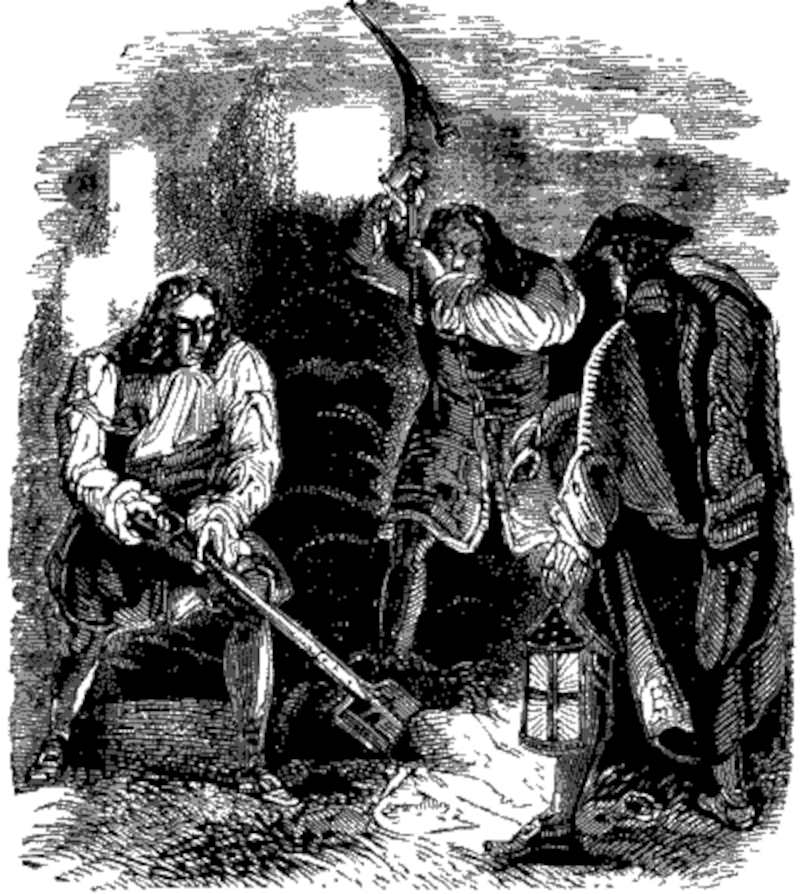
“That will do for the present,” said Chillingworth; “now let me and Charles take a turn with our shovels, and you will get on again presently. Throw the earth up on the bank in one heap, so that we can put it on again without attracting any attention to the spot by its being left in clods and uneven.”
“Exactly,” said Henry, “else the body will be discovered.”
They began to shovel away, and continued to do so, after it had been picked up, working alternately, until at length Charles stuck his pick-axe into something soft, and upon pulling it up, he found it was the body.
A dreadful odour now arose from the spot, and they were at no loss to tell where the body lay. The pick-axe had stuck into the deceased’s ribs and clothing, and thus lifted it out of its place.
“Here it is,” said the doctor; “but I needn’t tell you that; the charnel-house smell is enough to convince you of the fact of where it is.”
“I think so; just show a light upon the subject, doctor, and then we can see what we are about—do you mind, doctor—you have the management of the lantern, you know?”
“Yes, yes,” said Chillingworth; “I see you have it—don’t be in a hurry, but do things deliberately and coolly whatever you do—you will not be so liable to make mistakes, or to leave anything undone.”
“There will be nothing of any use to you here, doctor, in the way of dissection, for the flesh is one mass of decay. What a horrible sight, to be sure!”
“It is; but hasten the search.”
“Well, I must; though, to confess the truth, I’d sooner handle anything than this.”
“It is not the most pleasant thing in the world, for there is no knowing what may be the result—what creeping thing has made a home of it.”
“Don’t mention anything about it.”
Henry and Charles Holland now began to search the pockets of the clothes of the dead body, in one of which was something hard, that felt like a parcel.
“What have you got there?” said Chillingworth, as he held his lantern up so that the light fell upon the ghastly object that they were handling.
“I think it is the prize,” said Charles Holland; “but we have not got it out yet, though I dare say it won’t be long first, if this wind will but hold good for about five minutes, and keep the stench down.”
They now tore open the packet and pulled out the papers, which appeared to have been secreted upon his person.
“Be sure there are none on any other part of the body,” said Chillingworth, “because what you do now, you had better do well, and leave nothing to after thought, because it is frequently impracticable.”
“The advice is good,” said Henry, who made a second search, but found nothing.
“We had better re-bury him,” said the doctor; “it had better be done cleanly. Well, it is a sad hole for a last resting-place, and yet I do not know that it matters—it is all a matter of taste—the fashion of the class, or the particular custom of the country.”
There was but little to be said against such an argument, though the custom of the age had caused them to look upon it more as a matter of feeling than in such a philosophical sense as that in which the doctor had put it.
“Well, there he is now—shovel the earth in, Charles,” said Henry Bannerworth, as he himself set the example, which was speedily and vigorously followed by Charles Holland, when they were not long before the earth was thrown in and covered up with care, and trodden down so that it should not appear to be moved.
“This will do, I think,” said Henry.
“Yes; it is not quite the same, but I dare say no one will try to make any discoveries in this place; besides, if the rain continues to come down very heavy, why, it will wash much of it away, and it will make it look all alike.”
There was little inducement to hover about the spot, but Henry could not forbear holding up the papers to the light of the lantern to ascertain what they were.
“Are they all right?” inquired the doctor.
“Yes,” replied Henry, “yes. The Dearbrook estate. Oh! yes; they are the papers I am in want of.”
“It is singularly fortunate, at least, to be successful in securing them. I am very glad a living person has possession of them, else it would have been very difficult to have obtained it from them.”
“So it would; but now homeward is the word, doctor; and on my word there is reason to be glad, for the rain is coming on very fast now, and there is no moon at all—we had better step out.”
They did, for the three walked as fast as the nature of the soil would permit them, and the darkness of the night.
Previous Chapter Table of Contents Next Chapter
__________________________
1. This appears to be an archaic use of the word patent. The Oxford English Dictionary suggests it dates back to the 1300s, when patent was used as a synonym of potent. [Patent @ OED]
2. The word singular can be used in several ways. In the context of the story, it indicates something that is unusual, odd, or peculiar. [Singular @ Merriam Webster]
3. More commonly used to indicate something is extremely good, terrific can also be used as a synonym for “extraordinary” and “frightful”. Given the context of its use in the story, the latter option seems most appropriate. [Terrific @ Merriam-Webster]https://www.merriam-webster.com/dictionary/terrific
4. At the point in the chapter there is a sudden shift of focus, along with a section break. The abrupt nature of the change may indicate the omission of one or more penny dreadful magazines from the original 3-volume book of Varney the Vampire. Scanned copies I’ve been able to check, confirm this sudden shift is present in the book.
__________________________