
Witch In-Grain by R. Murray Gilchrist
“Witch In-Grain” was first published 6 May 1893 in The National Observer. It was republished the following year in Gilchrist’s story collection The Stone Dragon and Other Tragic Romances. “Witch In-Grain” has also been included in several mixed-author anthologies including The Thrill of Horror (1975), A Treasury of Victorian Ghost Stories (1981), and Great Horror Stories: 101 Chilling Tales (2016).
About R. Murray Gilchrist
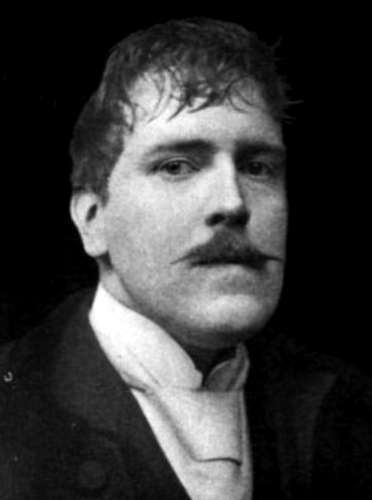
Robert Murray Gilchrist was a British writer who wrote regional interest books about the Peak District, and also penned an impressive number of short stories and novels. He was born in Sheffield, England, on 6 January 1917, was educated at Sheffield Royal Grammar School, and spent much of his later life in Holmesfield, North Derbyshire.
Gilchrist is believed to have commenced his writing career in 1890, when he published his first novel, Passion the Plaything. He wrote a further 21 novels, and around 100 short stories, some of which he included in his six anthologies.
Despite the large output of work, during his life, Gilchrist failed to achieve much recognition, and was never a main player in literary circles, a fact some literary critics commented on. As did some of his colleagues. Fellow author and friend of Gilchrist, Eden Phillpotts, dedicated his story collection, The Striking Hours, to him, stating he considered Gilchrist “the master of the short story”. Nevertheless, Gilchrist’s first anthology, The Stone Dragon and Other Tragic Romances (1894), failed to get much attention.
This lack of recognition continued until the mid-197os, when Hugh Lamb drew attention to Gilchrist’s work by selecting five of his stories for publication in horror anthologies he was editing, calling him “an unrecognized master of the macabre story”, and heaping much praise on the previously neglected The Stone Dragon and Other Tragic Romances.[1] Later, in The Penguin Encyclopedia of Horror and the Supernatural, literary scholar Jack Sullivan described Gilchrist as “a neglected master of horror who deserves revival”.[2]
~
~
Witch In-Grain
by R. Murray Gilchrist
Of late Michal had been much engrossed in the reading of the black-letter books that Philosopher Bale brought from France. As you know I am no Latinist—though one while she was earnest in her desire to instruct me; but the open air had ever greater charms for me than had the dry precincts of a library. So I grudged the time she spent apart, and throughout the spring I would have been all day at her side, talking such foolery as lovers use. But ever she must steal away and hide herself amongst dead volumes.
Yestereven I crossed the Roods, and entered the garden, to find the girl sitting under a yew-tree. Her face was haggard and her eyes sunken: for the time it seemed as if many years had passed over her head, but somehow the change had only added to her beauty. And I marvelled greatly, but ere I could speak a huge bird, whose plumage was as the brightest gold, fluttered out of her lap from under the silken apron; and looking on her uncovered bosom I saw that his beak had pierced her tender flesh. I cried aloud, and would have caught the thing, but it rose slowly, laughing like a man, and, beating upwards, passed out of sight in the quincunx. Then Michal drew long breaths, and her youth came back in some measure. But she frowned, and said, ‘What is it, sweetheart? Why hast awakened me? I dreamed that I fed the Dragon of the Hesperidean Garden.’ Meanwhile, her gaze set on the place whither the bird had flown.
‘Thou hast chosen a filthy mammet,’ I said. ‘Tell me how came it hither?’
She rose without reply, and kissed her hands to the gaudy wings, which were nearing through the trees. Then, lifting up a great tome that had lain at her feet, she turned towards the house. But ere she had reached the end of the maze she stopped, and smiled with strange subtlety.
‘How camest thou hither, O satyr?’ she cried. ‘Even when the Dragon slept, and the fruit hung naked to my touch…. The gates fell to.’
Perplexed and sore adread, I followed to the hall; and found in the herb garden the men struggling with an ancient woman—a foul crone, brown and puckered as a rotten costard. At sight of Michal she thrust out her hands, crying, ‘Save me, mistress!’ The girl cowered, and ran up the perron and indoors. But for me, I questioned Simon, who stood well out of reach of the wretch’s nails, as to the wherefore of this hurly-burly.
His underlings bound the runnion with cords, and haled her to the closet in the banqueting gallery. Then, her beldering being stilled, Simon entreated me to compel Michal to prick her arm. So I went down to the library, and found my sweetheart sitting by the window, tranced with seeing that goblin fowl go tumbling on the lawn.
My heart was full of terror and anguish. ‘Dearest Michal,’ I prayed, ‘for the sake of our passion let me command. Here is a knife.’ I took a poniard from Sir Roger’s stand of arms. ‘Come with me now; I will tell you all.’
Her gaze still shed her heart upon the popinjay; and when I took her hand and drew her from the room, she strove hard to escape. In the gallery I pressed her fingers round the haft, and knowing that the witch was bound, flung open the door so that they faced each other. But Mother Benmusk’s eyes glared like fire, so that Michal was withered up, and sank swooning into my arms. And a chuckle of disdain leaped from the hag’s ragged lips. Simon and the others came hurrying, and when Michal had found her life, we begged her to cut into one of those knotted arms. Yet she would none of it, but turned her face and signed no—no—she would not. And as we strove to prevail with her, word came that one of the Bishop’s horses had cast a shoe in the village, and that his lordship craved the hospitality of Ford, until the smith had mended the mishap. Nigh at the heels of his message came the divine, and having heard and pondered our tale, he would fain speak with her.
I took her to the withdrawing-room, where at the sight of him she burst into such a loud fit of laughter that the old man rose in fear and went away.
‘Surely it is an obsession,’ he cried; ‘nought can be done until the witch takes back her spells!’
So I bade the servants carry Benmusk to the mere,[3] and cast her in the muddy part thereof where her head would lie above water. That was fifteen hours ago, but methinks I still hear her screams clanging through the stagnant air. Never was hag so fierce and full of strength! All along the garden I saw a track of uprooted flowers. Amongst the sedges the turmoil grew and grew till every heron fled. They threw her in, and the whole mere seethed as if the floor of it were hell. For full an hour she cursed us fearsomely: then, finding that every time she neared the land the men thrust her back again, her spirit waxed abject, and she fell to whimpering. Two hours before twelve she cried that she would tell all she knew. So we landed her, and she was loosened of her bonds and she mumbled in my ear: ‘I swear by Satan that I am innocent of this harm! I ha’ none but pawtry secrets. Go at midnight to the lows and watch Baldus’s tomb. There thou shalt find all.’
The beldam tottered away, her bemired petticoats clapping her legs; and I bade them let her rest in peace until I had certainly proved her guilt. With this I returned to the house; but, finding that Michal had retired for the night, I sat by the fire, waiting for the time to pass. A clock struck the half before eleven, and I set out for King Baldus’s grave, whither, had not such a great matter been at stake, I dared not have ventured after dark. I stole from the garden and through the first copse. The moon lay against a brazen curtain; little snail-like clouds were crawling underneath, and the horns of them pricked her face.
As I neared the lane to the waste, a most unholy dawn broke behind the fringe of pines, looping the boles with strings of grey-golden light. Surely a figure moved there? I ran. A curious motley and a noisy swarmed forth at me. Another moment, and I was in the midst of a host of weasels and hares and such-like creatures, all flying from the precincts of the tomb. I quaked with dread, and the hair of my flesh stood upright. But I thrust on, and parted the thorn boughs, and looked up at the mound.
On the summit thereof sat Michal, triumphing, invested with flames. And the Shape approached, and wrapped her in his blackness.
Robert Murray Gilchrist (1867 – 1917)
__________________________________
1. Lamb, Hugh, Tales from a Gas-Lit Graveyard. Dover Publications, (Reprint) ISBN 048643429X (pp. 142-143).
2. Sullivan, Jack, The Penguin Encyclopedia of horror and the supernatural New York, N.Y., U.S.A. : Viking, 1986. ISBN 0670809020 (p. 171).
3. A mere is a lake that is unusually shallow in relation to its width.
__________________________________