A Dead Man’s Teeth by Sabine Baring-Gould
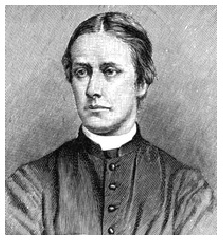 “A Dead Man’s Teeth” was first published in 1905 in Monsieur Pichelmère, and Other Stories. In 1975, Hugh Lamb included it in the mixed-author anthology Terror by Gaslight: More Victorian Tales of Terror, a book that has been reprinted several times.
About Sabine Baring-Gould
Sabine Baring-Gould (1834 — 1924) was an English writer and scholar. He was also an Anglican Priest.
Although he is probably best remembered for writing the hymns Onward Christian Soldiers and Now the Day is Over, Baring-Gould was a prolific writer whose bibliography consists of over 1,200 publications, including The Book of Werewolves (non-fiction).
A Dead Man’s Teeth
by Sabine Baring-Gould
(Online Text)
“Yes, sir, it is a grave, what you see there, and what is more I can tell you whose grave it is, or was. And there’s a very coorious sarcumstance [1] is connected with that there grave, and if you don’t mind sitting down on that piece of rock for five minutes, I’ll tell you all about it.”
I was examining for geological purposes a quarry in Cornwall that had been opened in the side of a hill for the extraction of stone. I observed a sort of niche in the uppermost layer of rock, under the earth which rose some four feet above the surface of the rock.
The niche was about two feet deep and the same breadth, and the sides were cut perpendicularly. It was clearly artificial, and at once struck me as being a section of a grave. There was no churchyard interfered with, so that I supposed the grave was prehistoric, and at once inquired whether any bronze or flint weapons had been found when it was cut through.
“No, sir,” said the quarryman, “nothing of the sort as far as I know; it was the top of the grave we cut through, and when we sent the pick into it, the gentleman’s head came down into the quarry.”
“Gentleman’s head? What gentleman’s head?”
“Well, sir, I did not know at the time. It gave me a lot of trouble did that head, or rather the teeth from it. If you’ll be so good as to sit down on that stone, I’ll tell you all about it, and I reckon it will be worth your trouble. It’s as curious as story as you have ever heard.”
“I will listen certainly. But excuse me one moment. I should like to crawl up the side of the quarry and examine the grave.”
“It’s my lunch time, and I’ve nothing to do but to eat and talk for half-an-hour,” said the quarryman, “so I’ll tell you all the whole story, when you’ve been up and come down again. There’ll be bones there. You’ll find his neck; we cut off the head of the grave. But whatever you do, leave the bones alone. Don’t carry any away with you in your pocket, or you’ll be sorry.”
I made the exploration I required and found that a grave had been cut in the rock. Clearly, when the interment took place, those who made the grave did not consider that there was a sufficient depth of earth, and they had accordingly cut out a hole in the rock below the soil, to accommodate the dead man. Bones were still in situ. I could find no trace of coffin, but in all likelihood, if there had been one there, it had rotted away, and the gravelly soil from above had fallen in on all sides, and had taken the place of the wood as it decomposed. And if there had been a mound above the dead man, the sinking in after decomposition had caused it to disappear. There were bushes of heather above the grave, but nothing to indicate that a tomb had been in the place, as far as could be judged from above. Its presence would not have been guessed had it not been revealed by the operations of the quarrymen.
Having completed my observations, I returned to the bottom, and seated myself on the stone indicated by the workman. He occupied the top of another, and was engaged on a pie, from which he cut large pieces and thrust them between knife and thumb into his mouth. As he opened this receptacle I observed that the gums were ill-provided with teeth so that mastication must be imperfect.
“You see, sir,” said the quarryman, “when we cut that new slice we went slap through the head of the grave, and never knowed there was a grave there, till down came the head, like a snowball. I was sitting here, and I’d just got out my dinner, when I heard James a-hollerin’ to me to look out. I looked up, and saw that there skull come jumping down the side, and before I could get up down came the skull and flopped right among my victuals. There it sat in my lap, looking up in my face, as innocent as a babe, so it seemed to me.
“Well, sir, I dare say you know that there ain’t a better preservative against toothache than to carry about a dead man’s tooth in your pocket. Dead men’s teeth don’t lie about like empty snail shells, and I’d often wished to have one. I suffer terrible from my teeth. I’ve been kept raving with pain night after night, and one ain’t up to work when one has been kept raving all night, either with teeth or babies. So you can imagine I was uncommon joyful when that head came bouncing into my lap. I found the teeth weren’t particularly tight in, and with my knife I easily got a tooth or two out. I thought I’d be square all round, so I got out a back tooth and an eye tooth and a front one. Then I thought I was pretty well set up and protected against toothache. I got my wife to sew ‘em up in a bit o’silk and hung it round my neck. I may say this—from that day so long as I wore the dead man’s teeth I never had a touch of toothache.”
“And how long did you wear them?”
“Three days, sir.”
“Not more? Why did you not retain them?”
“I’ll tell you why, if you’ll listen to me.”
“Certainly. But what have you done with the skull?
“Chucked it away. It weren’t no good to nobody—least of all to the owner. And for me—I’d got out of it all I wanted.”
“You have not got the teeth now?”
“No. I kept them for three days and then chucked them away.”
“Have you had toothache since?”
“Terrible; but I had what was worse when I had the teeth.”
“Well, go on and tell me what the ‘worse’ was.”
“So I will, if you’ll listen to me. Well, sir, I had them teeth done up in a bit of silk, and hung round my throat. The first night I went to bed, that was Saturday, I had the little bag round my neck. I hadn’t hardly laid my head on the pillow when I found I wasn’t no more what I ought to have been. In the first place, I hadn’t gone to bed with my clothes on, and no sooner was my head on the pillow than I was in a red coat and breeches and gaiters; and what is more, in the second place, I’d laid me down to rest, and I found myself on horseback, tearing over the country, jumping hedges, tally-hoing—me as never rode a horse in his life, and never tally-hoed, and wouldn’t do it to save my soul. I knowed all the while I was doing wrong. I knowed I’d got to preach in our chapel next evening, the Sabbath Day—and here was I in a red coat, and galloping after the hounds, and tearing after a fox, and swearing awful! I couldn’t help myself. I believe my face was pink as my coat. I tried to compose my mouth to say Hallelujah, but I couldn’t do it—I rapped out a—but, sir, I daren’t even whisper what I then swore at the top o’ my voice. It was terrible—terrible!” I saw the quarryman’s face bathed in perspiration. The thought of what he had gone through affected him, and his hand shook as he heaved a lump of pastry to his quivering lips.
“I tried to think I was in the pulpit; but it was no good; I was whacking into my cob, and kicking with spurs into her flanks, and away she went over a five-barred gate—it was terrible—terrible, to a shining light, sir,—such as I be.”
The man heaved a sight and wiped his brow and cheeks, and rose with his pudding bag.
“All the Sabbath Day after that,” continued the quarryman, “I wasn’t myself. It lay on my conscience that I’d done wrong; and when I preached in the evening, there was no unction in me, no more, sir, than you could have greased the fly-wheel of your watch with. I didn’t feel happy, and it was with a heavy heart and a troubled head that I went to bed on the Sabbath night.” He heaved another sigh, and folded up his lunch-bag.
“Will you believe it, sir? No sooner had I closed my eyes than I was in a public house. I—who’ve been in the Band of Hope ever since I was a baby. There I was, just out of the pulpit at Bethesda, and in the ‘Fox and Hounds’ drinking. I tried to call out for a ginger beer, but the words got altered in my throat to Whiskey toddy. And what was more, I was singing—roaring out at the top of my voice—
‘Come, my lads, let us be jolly,
Drive away dull melancholy;
For to grieve it is a folly
When we meet together!’ ”
The quarryman covered his eyes with his hands—he was ashamed to look up.
“If that wasn’t bad enough, the words that followed were worse—and I a teetotaler down to the ground,
‘Here’s the bottle, as it passes,
Do not fail to fill your glasses;
Water drinkers are dull asses
When they’re met together.’
“All the while I sang it I knew I was saying goodbye to my consistency. I was going against my dearest convictions. But I couldn’t help myself, it was as though an evil spirit possessed me. I was myself and yet not myself. It was terrible—terrible—terrible!”
The quarryman swung his pastry bag, and smote his breast with it.
“That wasn’t all,” he continued, and lowered his tone. “There was an uncommon pretty barmaid with red rosy cheeks and curling black hair; and somehow I got my arm round her waist. I knowed my wife was looking on, and, sir, I knowed the consequences would be awful—awful—simply awful.”
The quarryman’s head sank on his knees, he clasped his hands over the back of his head, and groaned for full five minutes. Presently he looked up, pulled himself together, and continued his narrative.
“The worst of all is behind. I was very busy on Monday, as I was on Mr. Conybeare’s committee. We were in for the election, and I’m tremendous strong as a Liberal, and I reckon I can influence a good many votes in my district of Cornwall. Well, sir, I’d been about canvassing for Mr. Conybeare very hard, yet all the while I had a sort of deadly fear at my heart that what I’d been doing, both hunting and drinking, and swearing and singing, would come out in public, or would be thrown in my teeth by the Conservatives, and might damage the good cause. But no one said anything about it on Monday, and towards evening my mind was more at ease.
“I was very tired when I went to bed, for I had been working, as I said, very hard indeed, and persuading of obstinate politicians is worse than breaking stones for the road, and far worse than converting of obstinate sinners. No sooner had I laid my head on the pillow than—will you believe it, sir?—I was in the full swing of the election. I didn’t know it was coming on so fast. I thought it about three weeks to go, but not a bit of it. They’d set up a polling place in the Board School, and there was I swaggering up to register my vote. There were placards—Unionist on one side, but I wouldn’t look at them; on the other side were the Radical posters—from Mr. Conybeare—and I knowed my own mind. If any man in England be true and loyal to the G.O.M. that’s me. Well, sir, in I walked and gave my name. I knowed my number, and went as confident as possible into the little box and with my paper in one hand took the pencil in the other, wetted the pencil with my tongue to make sure it marked black enough, and then set down my cross. Will you believe it?—that spirit o’ perversity and devilry had come over me once more, and I’d gone and voted Conservative.”
The quarryman staggered back, and I had just time to spring to his aid. He had fainted. I threw water over his face till he came round and by degrees he was himself again.
“Awful! Awful! Wasn’t it?” said he. “Well sir, after that I would have nothing more to do with them teeth. They did it. I chucked ‘em away; toothache would be better all night long than the trials I had to undergo when I had them dead man’s teeth about me.”
“But have you not dreamed since?” I asked, looking at the pastry which, when he fainted, I had taken in hand.
“Yes, sir, often, very often; but then my dreams since have always been Nonconformist, Temperance and Radical dreams—and them’s wholesome.”
“You said something about knowing who it was whose grave you had disturbed?”
“Well, and so I believe I do. I did not know at the time, but afterwards, when I began to tell my story; then there was a talk about it and a raking and grubbing among old folk’s memories, and there was an old woman who said she could throw some light on the subject. Her tale was about a hundred years ago, or more perhaps, she could not be sure, there lived at the Old Hall one Squire Trewenna. The Hall has been pulled down because of the mines, and the Trewennas are all gone. Squire Trewenna was a terrible man for hunting and drinking, and was, moreover, a regular Conservative. He was a fast chap, and no good to nobody but to dogs and horses, and before he died he begged that he might be buried on the brink of the moor where he’d ridden so often and enjoyed himself so much, and had killed a tremendous big fox in the last hunt he ever went out in before gout got to his stomach. And he said he wanted no headstone over him, that fox and hounds and horses might go over his grave. Well, folks forgot, as there was no headstone, where he lay, exact, and old Betty Tregellas says she believes what we cut into was Squire Trewenna’s grave. I think so too, for how else was it that when I had those teeth about me I was so possessed by a spirit of unrighteousness and drinking and Conservatism? I reckon you’ve had a Board School education and been to the University, and are a learned man. Tell me, am I not right?”
Sabine Baring-Gould (1834 — 1924)
_______________________________
1. Coorious sarcumstance: Curious circumstance. (The author was trying to capture the character’s dialect.) ↩
_______________________________