
The Cellar (2024) – Film Review
 The Cellar is an indie horror film written and directed by British actor Jamie Langlands. His first stint as director was back in 2014, when he directed a 12-minute short called Survival. With a runtime of 85 minutes, The Cellar is a more ambitious project that knocks spots off many films produced on higher budgets. Special effects in The Cellar are limited to tinted contacts lenses, retracting hypodermic needles, and some clever use of mirrors—but the story and quality of acting are strong enough to carry the film along without the need for all the overly-flashy technical wizardry that is so often used to help prop things up in bigger budget productions.
The film begins by introducing a young woman who is gagged and tied to a chair inside a cell-like room in an underground complex, where the corridors are dimly lit by electric lighting. However for, reasons unknown, the room of her confinement is illuminated by flickering candles, and she succeeds in using one of them to burn the ties from her right wrist. Unfortunately, it’s too little, too late because, before she can free her other arm, a man in a white coat arrives and injects something into her neck, rendering her dead or unconscious.
The central character, Abigail (Meghan Adara), is introduced after the opening credits, when she arrives late to a church-organized group therapy session for people fighting various types of addiction. The action then cuts back to another underground cell, where another young woman has what appears to be a fatal encounter with a man in black, whose face is hidden behind an ominous mask.
Abigail wakes up on the floor of a nearby cell. Angered by her predicament, she springs into action and soon escapes her room of confinement thanks to some innovative use of her bra. This scene sets the tone for things to come by letting viewers know Abigail is a resourceful girl who is going to give her captors’ a run for their money.
Much of the film consists of cat and mouse sequences, where Abigail is trying to escape the subterranean corridors, while also avoiding the black-clad, somewhat demonic-looking individuals who appear to be responsible for her abduction. These scenes are interspersed with flash-back sequences featuring Abigail’s last group session. One by one, they fill in the blanks, providing a better idea of what’s going on.
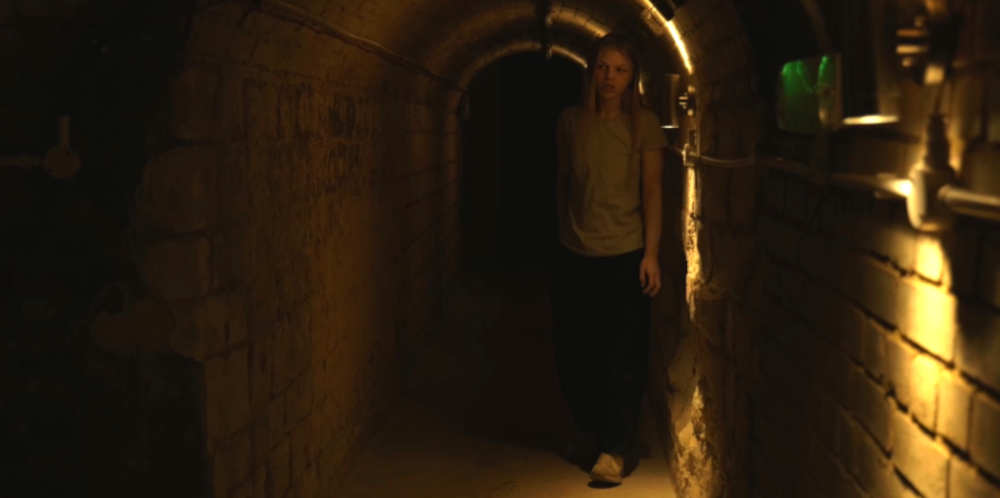
The second half of the film, brings the action up from the cellar into the house above it, a building that seems somewhat small in comparison to the labyrinthine network of tunnels and rooms hidden beneath it. Adding another hefty slice of the odd to Abigail’s predicament, the house is decorated and furnished in a way that suggests she may have slipped back in time to the Victorian era. However, this cannot be the case because, when Abigail finds her phone, she is able to use it to attempt to call for help.

You don’t have to get too far into The Cellar before it becomes obvious, there’s a lot more going on than meets the eye; and a number of supernatural occurrences, that begin midway through the film, suggest Abigail may not only be battling for her freedom, but for her soul as well.
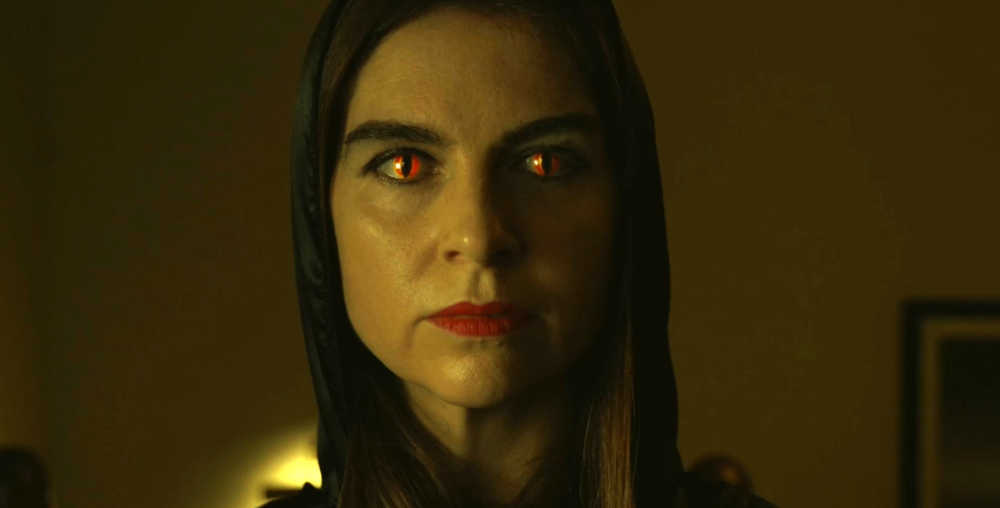
Indie films are often held back by issues such as poor-quality acting, ridiculous scripts, and shaky camerawork. This is not the case with The Cellar. Other than a couple of instances when the camera briefly loses focus, there’s not much to complain about. The picture quality is excellent, and the settings are suitably ominous. The choice of backing music is very good too, and does much to help maintain viewer suspense and foster the dark atmosphere that is evident throughout most of the film.
As for the storyline, it works well and the pre-credits sequence gets things off to a good start, making it clear the cellar is a dangerous place to be, and mercy is unlikely to be on the agenda. However, with a film like this, viewers invariably want to know what’s going on. Unfortunately, although it becomes clear who abducted Abigail, and—to some extent—why, viewers are still left with some gray areas. I watched the film twice, and I’m still unsure about a couple of things. I also have mixed feelings about the ending, which is somewhat open to viewer interpretation. It certainly works, but I was hoping for something more. Meghan Adara does such a good job of building a strong character that, after Abigail has shown such great fortitude and achieved so much, it would have been nice to have seen a happier resolution.
~~~