The Immortal Skeleton by Karel J. Erben
Also known as Koshchei (Коще́й), The Immortal Skeleton is a mythical entity that figures in several Russian folktales. The story below is taken from Russian and Bulgarian Folk-Lore Stories (1907). The anthology was edited by Karel J. Erben.
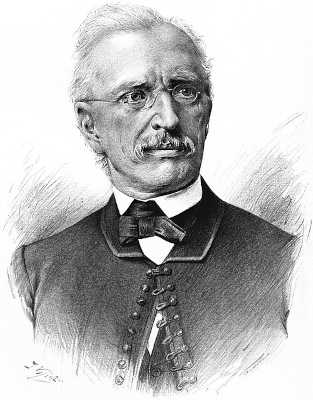
About Karel J. Erben
Karel Jaromír Erben (November 7, 1811 – November 21, 1870) was a Czech historian, lawyer, writer, poet, and translator. He was also a collector of of Czech folk songs and fairy tales.
The son of a shoemaker, Erben was born in Miletin, and educated at the Hradec Králové Grammar School, where he funded his studies by working as a piano teacher. He continued his education at the Faculty of Arts, Charles University, in Prague. Although his parent wished him to become a teacher, he ultimately decided to study law instead, and, during his student years, began contributing his poems to Czech magazines.
Although Erben was an important figure in the Czech National Revival, and held a number of prestigious positions in the city of Prague, he is primarily remembered as a collector of folk tales.
The Immortal Skeleton
by Karel J. Erben
(Online Text)
In a certain kingdom, on a certain estate, lived a king; this king had three sons, ail grown up, when all at once the Immortal Skeleton carried off their mother. The eldest son begged his father to let him go in search of her. The father consented, he rode off, and nothing more was heard of him. The second son waited and waited, and at last begged leave of his father, rode off, and nothing more was heard of him either. The little son, Ivan Czarevitch, said to his father: “Batyushka![1] let me go and find mammy!” His father would not let him, but said: “Your brothers I have lost. Would you, too, desert me? I shall die of sorrow.”
“No, batyushka, give me leave; I go with or without it.” The father gave him leave.
Ivan Czarevitch went to select a horse, but do what he would he could not find one to his liking; so he goes along the Street hanging his head. An old woman now appeared from I know not where: “Why, Ivan Czarevitch, do you hang your head?”
“Look you, old dame, I lay it on my hand, slap it with the other, and it will be jolly moist.”
The old woman ran round by a side Street, again came to meet him, and said: “Good morrow, Ivan Czarevitch, why do you hang your head? ” He pondered: “Why does the good dame ask these questions? Perhaps she could help me”; and says to her: “The fact is, my good woman, I cannot find a horse to my liking.”
“Why rack your brains, stupid? Rather trust an old woman,” re-plied the beldame; “come with me.” She led him to a mountain, and pointed out a certain spot. “Clear away the earth here.”
Ivan Czarevitch dug, and saw an iron slab with twelve locks; these locks he at once tore off, and folding doors opened: he entered the underworld. Here, chained with twelve chains, was a magnificent steed; he evidently perceived that it was the rider destined for him, neighed, struggled and broke all twelve chains. Ivan Czarevitch donned the rich apparel, bridled the steed, saddled him with his Circassian saddle, gave the old woman some money, saying, “Thanks and bénédiction, my good woman,” seated himself on the horse and rode away.
Far away he rode, and at last reached a mountain — an enormous, precipitous mountain! It was quite impossible to ride a horse over it. Now, his brothers were riding near the mountain: they greeted him, and ail three rode on together; finally they reached an iron stone, one hundred and fifty poods in weight, with this inscription on it: “Whoever can throw this stone on to the mountain will be able to walk over it as well!” The elder brother could not raise the stone, but Ivan Czarevitch, at one fling, threw it on to the mountain, and that instant a flight of steps appeared on the mountain side. He left his horse, drew blood from his little finger, and said: “If the blood in the goblet turns black, do not wait for me, you will know that I am dead.” Then he took leave of them and went his way. He turned and clomb the mountain side, and what do you think he saw there? Well, all sorts of forests, all sorts of berries, and all sorts of birds. Far, very far, trudged Ivan Czarevitch, and at last reached a house, an enormous house! In it lived a royal daughter, the Immortal Skeleton had carried her off. Ivan Czarevitch walked round the outer wall, but not a door was to be seen. The royal daughter, seeing a man, came out on to the balcony, and called out to him: “On the boundary wall yonder, observe there is a scutcheon, touch it with your little finger, and it will become a door.” Ivan Czarevitch did so and entered the house. The girl welcomed him, brought him meat and drink, and inquired his object in coming. He related that he had come to rescue his mother from the Immortal Skeleton. On this the girl said : “ It will be difficult to gain access to your mother, Ivan Czarevitch! Why, he is immortal, and will kill you. We have here, however, a sword fifty poods in weight; if you can brandish it, be off and try your luck!”
Ivan Czarevitch not only raised and brandished the sword, but tossed it up in the air, and then went further. He reached a second house, and knowing how to find the door, entered it, and lo! there was his mother! She embraced him and wept over him. Here, too, to try his strength, he tossed up a bail one thousand and five hundred poods in weight. The time now drew near for the homecoming of the Immortal Skeleton, and his mother stowed him away. All at once the Immortal Skeleton entered the house and said: “Phu! Phu! Russian bones have never been seen or heard of, but a Russian bone has come even to our courtyard. Who has been with you? Your son,eh?”
“God be with you! What is the matter with you? You have been flying over Russia, all snapping up Russian souls, and got their fancies into your bead,” replied Ivan Czarevitch’s mother, and herself approached the Immortal Skeleton with fond words, and further inquired of him: “Where, Immortal Skeleton, is your death kept?”
“My death,” he said, “is in such and such a place: there stands an oak, under the oak a locker, in tbe locker a bear, in the bear a duck, in the duck an egg, and in the egg my death.” The Immortal Skeleton said this, tarried a short while, and then flew off.
The fitting moment came. Ivan Czarevitch bade bis mother farewell, and took his way in search of the Immortal Skeleton’s death. On and on he trudged, a long time, without eating or drinking; was dying to eat something, but reflected: “It would be so much time lost!” All at once, lo! a young wolf. He wished to kill it. Tbe mother wolf sprang out of her lair, and said: “Do not slay my child. I will requite you.”
“ Be it so.” Ivan Czarevitch spared the young wolf, and went further. He saw a crow. “Stay,” he thought; “now I really will have a bite.” He loaded his gun and was about to shoot; but the crow said: “Do not slay me and I will requite you.” Ivan Czarevitch pondered, and spared the crow. He went further, reached a sea and paused on the shore. At this moment, all at once, a young pike leapt out of the water and fell on the shore. He seized it and mortally longed to eat it, and said to himself: “Now, at last, I will eat.” But the mother pike appeared from I know not where and said: “Do not slay my child, Ivan Czarevitch, and I will requite you.” So be spared the young pike, too.
How was he to cross the sea ? He sat on tbe shore and pondered. The pike seemed to know bis thoughts perfectly, and lay full length on the surface. Ivan Czarevitch crossed on her back, as over a bridge; reached the oak where lay the Immortal Skeleton’s deatb, found the locker, opened it. Out skipped the bear, and ran off. Where was he to get bold of the bear? Ivan Czarevitch was in a great fright because be had allowed the bear to escape; thought and thought in vain; but the wolf, who he bad not killed, rushed after it, seized it and brought it to Ivan Czarevitch. He was delighted, seized the bear, tore it open, and, as be did so, out flew the duck and fluttered away. He took aim, fired, and missed it. Again he was in despair. But now, from I know not where, the crow and the young crow appeared, darted after the duck, seized it and brought it to Ivan Czarevitch. He was delighted; he had got the egg; returned, reached the sea, began to wash the egg, and it fell into the water. Immeasurably deep! How to recover it? Ivan Czarevitch was again in despair.
All at once the sea grew white with foam, and the pike brought him the egg, and then stretched itself across the sea. Ivan Czarevitch crossed the sea on its back, and made his way to his mother’s; reached the house; they greeted one another, and she again hid him. Meanwhile, the Immortal Skeleton flew home and said: “Phu! phu! Russian bones have never been seen or heard of: but surely something Russian is here.”
“What’s the matter with you, Skeleton dear ? There’s not anybody with me,” replied Ivan Czarevitch’s mother. The Skeleton again said: “I somehow feel ill at ease.” And Ivan Czarevitch flicked the egg as he did so; the Immortal Skeleton writhed with pain. Finally, Ivan Czarevitch drew out the egg, showed it, and said: “Look! Immortal Skeleton, there is your death.” The other fell on his knees before him and said: “Slay me not, Ivan Czarevitch! We will live as good friends; the whole universe shall be subject to us.” Ivan Czarevitch was not to be humbugged by his words, broke the egg, and the Immortal Skeleton dropped down dead.
Ivan Czarevitch and his mother took what was necessary, and went in the direction of their house. On their way, they turned aside to visit the king’s daughter, whom Ivan Czarevitch had previously called in at, and took her with them. They went further, and reached the mountain where Ivan Czarevitch’s brothers were waiting. The girl said: “Ivan Czarevitch, turn back to my house for me, I have forgotten my wedding dress, my diamond ring, and unsewn shoes.” Meanwhile, he let down his mother and the king’s daughter, who promised to marry him on his return home. The brothers received them, and then cut the lowering cord, so that Ivan Czarevitch could not be let down, and by threats forced their mother and the girl to say nothing about Ivan Czarevitch at home. They reached their kingdom once more. Their father was delighted with his children and their bride, only he grieved for the loss of his poor Ivan Czarevitch.
And Ivan Czarevitch returned to the home of his bride, took the wedding ring, the dress for the dowry, and the unsewn shoes, reached the mountain again, and tossed the ring from hand to hand. Twelve youths appeared and enquired: “What are your orders?”
“Get me down from this mountain, somehow.” The youths at once let him down. Ivan Czarevitch put on the ring, and they disappeared immediately. Then he went to his kingdom, and reached the town where his father and brothers lived, took up his abode with an old woman, and inquired: “What news, my good woman, is there in our kingdom?”
“What news, my young innocent? Why, our poor queen has been carried off by that brigand the Immortal Skeleton, and her three sons went in search of her; two found her and returned, but the third, Ivan Czarevitch, did not return, and no one knows where he is. The king is heartbroken about him. Now these princes and their mother brought home a king’s daughter from somewhere or other, and the eldest wants to marry her as soon as possible, but she has sent him first here and then there for her wedding ring, or to get one made as she requires it: the crier has been round again and again, but no one has discovered it.”
“Go quickly,” says the prince, “to the king, and say that you will make it. I guarantee that it be made.”
The old woman dressed herself in a few minutes, ran to the king and said: “Your royal majesty, I will make the wedding ring.”
“ Make it, my good dame; we like good folks like you. But if you fail to make it, — your head on a pike.” The old woman shook with fright, and went home to implore the prince to make the ring, but the prince was asleep, and she little thought that the ring was ready. He chaffed her ; and the old woman, all of a tremble, wept and rated him. “Look at you!” she said. “Now you are out of it, while I, you blockhead, am threatened with immediate death.” The old woman wept and wept, and then snoozed off.
Ivan Czarevitch got up early the next morning, and awakened the old woman. “ Rouse you, my good dame, hurry off, take the ring, and mark! do not accept more than a ducat for it. If they inquire who made the ring, say that you made it yourself; do not mention my name.” The old woman was delighted, and took the ring: the bride fitted it on. “That,” she said, “is what I want.” They brought out a plate full of gold; the old woman only took one ducat. The king said: “ Why, my good dame, do you take so little?”
“Oh! that is more than enough for me, your royal majesty; if I need more later, no doubt you will give it me.” So saying, the old woman took leave and retired.
But a short time elapsed when the news was brought that the bride had sent her husband for a suitable wedding dress, or to get what she wanted sewn for her. The old woman also this time (Ivan Czarevitch helping her) brought the required trousseau. Afterwards she brought the unsewn shoes, and of the ducats took only one, and said, “These things I made myself.” The people hear that on such and such a day is to be a wedding at the king’s, and eagerly await the day. But Ivan Czarevitch said to the old woman, “Note when they bring the bride under the wreath, and let me know.” The old woman did not let a moment slip by. Ivan Czarevitch at once donned royal robes, and came out. “Behold! good dame, such am I.” The old woman stood before him exclaiming, “Batyushka, forgive me for rating you!”
“God forgive you.” They went to the church. His brother was not yet there. He stood in line with the bride: they were married, and he escorted her to the palace. On their way they met the elder brother, who, seeing his bride married to Ivan Czarevitch, turned back shamefaced. The father rejoiced over Ivan Czarevitch, was informed of the wickedness of the elder brothers, and as soon as the wedding festivities were over, he drove the elder brothers into banishment, and appointed Ivan Czarevitch his successor.
Karel J. Erben (1811 – 1870)
_____________________________
1. Batyushka (Батюшка) is a Russian word. It means father. ↩
_____________________________