The Pageant of Ghosts by R. Murray Gilchrist
Like many of Gilchrist’s stories, “The Pageant of Ghosts” was first published in The National Observer. It appeared in the issue for 19 August 1892.
In 1894, Gilchrist republished “The Pageant of Ghosts” in his anthology The Stone Dragon and Other Tragic Romances. The story is seldom included in mixed-author anthologies but, in 2016, was reprinted in Great Ghost Stories: 101 Terrifying Tales.
About R. Murray Gilchrist
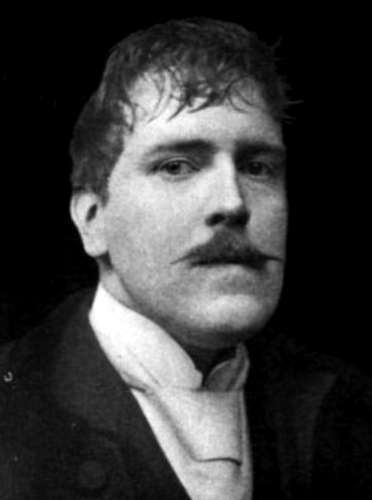
Robert Murray Gilchrist was a British writer who wrote regional interest books about the Peak District, and also penned an impressive number of short stories and novels. He was born in Sheffield, England, on 6 January 1917, was educated at Sheffield Royal Grammar School, and spent much of his later life in Holmesfield, North Derbyshire.
Gilchrist is believed to have commenced his writing career in 1890, when he published his first novel, Passion the Plaything. He wrote a further 21 novels, and around 100 short stories, some of which he included in his six anthologies.
Despite the large output of work, during his life, Gilchrist failed to achieve much recognition, and was never a main player in literary circles, a fact some literary critics commented on. As did some of his colleagues. Fellow author and friend of Gilchrist, Eden Phillpotts, dedicated his story collection, The Striking Hours, to him, stating he considered Gilchrist “the master of the short story”. Nevertheless, Gilchrist’s first anthology, The Stone Dragon and Other Tragic Romances (1894), failed to get much attention.
This lack of recognition continued until the mid-197os, when Hugh Lamb drew attention to Gilchrist’s work by selecting five of his stories for publication in horror anthologies he was editing, calling him “an unrecognized master of the macabre story”, and heaping much praise on the previously neglected The Stone Dragon and Other Tragic Romances.[1] Later, in The Penguin Encyclopedia of Horror and the Supernatural, literary scholar Jack Sullivan described Gilchrist as “a neglected master of horror who deserves revival”.[2]
The Pageant of Ghosts
by R. Murray Gilchrist
A late twilight in June. A wood-lark rippling in mid-air. Drowsy-scented ladies’ bed-straw in a marsh that was once a garden. On the terrace wall, beside the cedar, a stone urn with a lambent flame.
The casement hung open, and the excess of beauty and perfume drugged me: so that, with a sigh, I sank back into a moth-eaten sedan that had borne four generations to Court. Dried dust of lavender and rue filtered through the brocade lining, and grew into a mist, wherethrough the bird’s song waxed fainter and fainter. Indeed, I was just closing my eyes when the tuning of fifes and viols roused me with a start.
A shrill titter from the further end of the ball-room drew me from my seat. At the outer extremity of the oriel hung a curtain of Philimot velvet, lined inwardly with pale green silk: behind this I stole, and, parting the draperies from the wall, gazed towards the musicians’ gallery. Five men, dressed in styles that ranged from the trunk-hose and collared mantle of Elizabeth’s day to the pantaloons and muslin cravats of the third George, were arranging yellow music-sheets on the table. The youngest forced a harsh note from his viol, then struck another’s bald pate, and set all a-laughing. A grave silence followed. Then began just such a curious melody as the wind makes in a wood of half-blighted firs.
All the sconces were lighted of a sudden, and the martlets and serpents in the alt-relief above the panelling sprang into a weird life. Resting between the fire-dogs[3] on the open hearth were three logs, one of pine, another of oak, and a third of sycamore. The grey flame licked them hungrily, and the sap hissed and bubbled. The carved work of the walls was distinct: Potiphar’s wife wrapped her bed-gown about Joseph, Judith triumphed with the bloody head aloft, and in the centre Lot’s daughters paddled with his withered jowls.
I felt but little wonder at the change from stillness to life. As the last of my race, treasurer of a vast hoard of traditions, why should I be disturbed by this return of the creatures of old? I dragged forth the creaking sedan, and sat waiting.
A rusty, half-unstrung zither that hung near quivered and gave one faint note to the melody. Ere its vibration had ceased, Mistress Lenore entered through the arched doorway. Hour after hour had she plucked those wires that cried out in welcome.
Her fox-coloured tresses were wrought into a fantastic web; each separate hair twisted and coiled. A pink flush painted her cheeks, and her lustrous blue eyes were mirthful. She wore opals (unfortunate stones for such as love), and hanging from a black riband below her throat was the golden cross Prince Charles had sent her from Rome.
The legends of her character came in floods. Wantonly capricious at one moment, earnest and devout as a nun’s at another, her expression changed a thousand times as I beheld. Now she was racking her soul with jealousy; now pleading—as she alone could plead—for pardon; now, when pardon was won, laughingly swearing that her repentance was only feigned. As she neared my heart beat furiously, and I cried ‘Lenore! Lenore!’ My voice was low and broken (the music gave a loud burst then), but she passed without a word, her ivory-like hands almost hidden beneath jewels and lace. The further door stood open, and she disappeared.
Nowell the Platonist followed; a haggard middle-aged man in a long cloak of sable-edged black velvet. Forgetful of all save desire, he bore a scroll of parchment, whereon was written in great letters To Parthenia. This was the only outcome of his one passion. At the second window he paused, with a wry mouth, to gaze on that statue of Europa from whose arm he had hanged himself. Then his hands were uplifted to his head to force away the agony of despair; for hurrying towards him came the Mad Maid, who could not love him, being devoted to the memory of one wrecked at sea.
‘Why art thou in anguish?’ she said. ‘See my joy; laugh with me, dance with me. He returns to-morrow—the boat’s coming in. Ah, darling! ah, heart’s delight!’ And she held up her arms to a girandole[4] whose candles fluttered; but her face grew long, and thin, and pale, and she rested on a settee and drew from her pocket a dusky lace veil, which, being unfolded, discovered a ring with a burning topaz and a heart of silver. She leaned forward, resting her brow in her hands, and talked to the toys in her lap as if they understood.
To the veil she said, ‘No bride’s joy-blushes shalt thou conceal!’
To the ring, ‘Thou last gift of him who died and left me!’
To the heart, ‘O heart, thou hast endured! Thou art not broken!’
After a few tears she refolded all, and unbuttoning her bodice took from the bosom a miniature framed with pearls; but, as if afraid lest it should grow cold, she replaced it hurriedly, and seeing that Nowell beckoned towards her, glided on, sighing, and with downcast looks.
Then passed a cavalier in azure silk and snowy ruffled cravat and long-plumed cap of estate. He was whistling a song that threw all bachelors into humorous ecstasy. Who he was I know not: unless the courtier who had fought a duel with my Lord Brandreth, and had died in the wood near St. Giles’s Well, pressing convulsively in his right hand a dainty glove of Spanish kid. A merry fellow, quoth the legend, who loved the world and all in it, but who was over fond of his own jest.
Fidessa, the singer, entered next. She had brought her little gilt harp, and her lips were parted to join harmonies of voice and instrument. Bright yellow hair plaited in bands that formed a filigrain-bound coronet; eyes half-veiled, with sleepy lashes, hands fragile as sea-shells. It was the Verdi Prati, Mr. Handel’s celebrated song, that she adored most, and on the morrow she would sing it at Lincoln’s-Inn-Fields Theatre. At least she purposed to sing it then and there. Fate, however, had otherwise ordained: the to-morrow would never come, and the sweetheart at the upland grange might well write on her letters, ‘Darkness hath overcome me.’
Thin and pale Margot, her wanness heightened by dishevelled black curls, came forward in her scarlet cloak. Silent reproach was in her every feature; her eyes were stern and long-suffering. The prophecy that bound up her life with that of her dying twin was rapidly approaching consummation. Another moment and the direst pain filled her; for a loud cry from an outer chamber told her he was dead.
As she disappeared in the gloom, Nabob Darrington, himself in life the lover of a ghost, paced slowly along. A beau of the last century, wearing a satin flowered waistcoat and a coat and breeches of plum-coloured kerseymere, between his finger and thumb he held the diamond which he had brought from the East as a spousal gift for the woman who, unknown to him, had died of waiting. He was anticipating the meeting with her, and his brown cheeks flushed blood-red at the sound of a light footstep. He turned, saw one with violet eyes and tragic forehead; and with one joyous murmur they enfolded each other and passed.
Althea approached; a massive creature gowned in white and gold. In one hand she held a tangle of sops-in-wine, in the other, as symbolical kings hold globes, a bejewelled missal. The contention between the two lovers—the old, who had tyrannised until her life was of the saddest, and the new, who filled her with such wild happiness—was troubling her, and she was pondering as to which should gain the victory. She was just beginning to understand that to wait in passive indecision is to be torn with dragon’s teeth.
Barbara, with eyes like moon-pierced amethysts, followed, singing Ben Jonson’s Robin Goodfellow in a sweet quaver that was only just heard above the music. How strangely her looks changed—from maiden innocence to the awakening of love! from the height of passion to the abyss of despair!
But as she went the horizon was ripped from end to end, and a golden arrow leaped into the ball-room. Dawn had broken. The scent of the ladies’ bed-straw was trebly strong; the tired wood-lark sank lower and lower.
The room was empty—the pageant passed and done.
Robert Murray Gilchrist (1867 – 1917)
__________________________________
1. Lamb, Hugh, Tales from a Gas-Lit Graveyard. Dover Publications, (Reprint) ISBN 048643429X (pp. 142-143).
2. Sullivan, Jack, The Penguin Encyclopedia of horror and the supernatural New York, N.Y., U.S.A. : Viking, 1986. ISBN 0670809020 (p. 171).
3. During the Victorian era, fireplaces were often equipped with andirons (or fire dogs), which supported the wood being used as fuel.
4. A girandole is an ornamental, branched candlestick.
__________________________________