The Tale of the Turquoise Skull by Fergus Hume
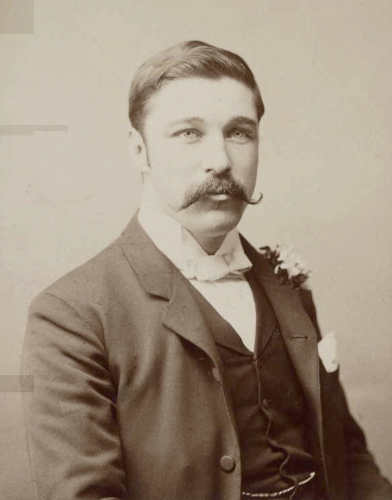
“The Tale of the Turquoise Skull” is a short story written in the the late 1800s by Fergus Hume. It was first published in 1896 in his anthology The Dwarf’s Chamber and Other Stories. The story is seldom reprinted, so many readers may encounter it here for the first time.
About Fergus Hume
Ferguson Wright Hume was a prolific British author of novels and short stories. He published more than 130 novels, along with several story anthologies. Although Hume is best known as a writer of thrillers, mysteries, and detective stories, he also wrote a number of ghost stories.
Hume was born in the village of Powick in Worcester, England. While he was still pr-school age, his family moved to New Zealand, where he studied law. Shortly after graduating from the University of Otago, Hume moved to Melbourne, Australia, accepted a position as a barrister’s clerk, and began writing plays in his spare time, but his attempts to place his plays with local theaters were unsuccessful.
In 1886, after publishers refused to consider his novel Mystery of a Hansom Cab, Hume published it himself. The book quickly became an international best seller. However, he sold the English and American rights to some Autralian bussinessmen for $50, so failed to cash-in on his works, phenomenal success. Often classed as the first modern mystery thriller, Mystery of a Hansom Cab is believed to have inspired Arthur Conan Doyle to write his first Sherlock Holmes story—A Study in Scarlet.
In 1888, Hume returned to England. After a few years living in London, he relocated to Thundersley, Essex. He died on 12 July 1932, and is buried in an unmarked grave in the local churchyard.
The Tale of the Turquoise Skull
by Fergus Hume
(Online Text)
Part 1
This story has been told by three different men. Each has embellished it according to his fancy, and constituted himself the hero. I object to these egotistical pilferers, for I am alone entitled to tell, in the first person, the tale of the turquoise skull. Should any one question my right to this principal role, I can point out that the forefinger of my left hand is missing. That loss substantiates my statement. I should like to know if those other three story-tellers lack the forefingers of their left hands. If not, they stand convicted of plagiarism.
When Harry Carstone and I went to the U. S. A. on a shooting excursion, we intended to strike for the Rockies. It was by no deliberate design that we found ourselves at Zacatecas. By a series of accidents which need not be set forth here, we drifted aimlessly southward. From New York we traveled to New Orleans, thence took ship to Vera Cruz, and, as a natural consequence, we terminated our journey in Mexico City. And here we should have remained, had not Fate, by her favorite device of feminine influence, lured us—or rather one of us—to Zacatecas. If Harry had not followed Lola Tepeaca from capital to province, he might now be alive. As it was, he left Mexico City for Zacatecas, where he found Lola, the turquoise skull, and a grave. I came out of the affair with my life and the loss of a finger. To save Harry I would have given willingly the whole hand. But it was not to be; and although I punished Lola for her evil deeds, such reprisal was but poor compensation for the death of my college chum.
Ostensibly we sought Zacatecas in the mining interest, but I gave up my time to sight-seeing, and Harry spent most of his with Lola. Only once did I accompany him to her dwelling; then, seeing that I was an inconvenient third, I went no more. As for Lola, she usually smoked cigarettes in a grass hammock swung on the azotea, while Harry sat at her feet and talked. I guessed what formed the gist of these conversations, from my friend’s flushed face and sparkling eyes at their conclusion. And, judging that such trifling was unwholesome, I ventured a remonstrance, which he promptly resented. Experience should have taught me the futility of interfering.
“You can’t marry the girl,” said I impatiently; “she is half Indian, and wholly diabolical.” Harry drew his brows together, as was his habit when annoyed. I remembered that sign of temper at Eton when he went up for punishment. Still, he answered temperately enough— “I know she is a half-caste, but she is not the—the other thing.”
“Isn’t she, though! If ever I saw evil in a woman’s eyes—”
“You need say no more, Frank,” he interrupted, hotly; “it is shabby to speak ill of a woman behind her back.”
“I will say it to her face if you like, Harry. Believe me, she is no good, and she will certainly get you into trouble.”
“I can take care of myself. I am no fool.”
“You are a man, at all events,” I retorted, “and all men are fools where a woman is concerned. Do you intend to present Lady Carstone with a half-caste daughter-in-law?”
“That is neither here nor there,” said he sulkily, and turned on his heel to intimate that my interference was uncalled for. Later on he left the hotel to call on his Venus Pandemos. Having been thus rewarded for my mediation, I walked to the Casa de la Estrella to visit Fray Benito. He was a Dominican monk of archaeological tastes, with whom I had forgathered shortly after my arrival at Zacatecas. His monastery—named after the star of Bethlehem—was a peaceful old dwelling, with courts and corridors, a wonderful chapel, and an extensive library. When Fray Benito was not praying in the chapel, he was reading in the library; and here I found him wrestling with the crabbed Latin of a priestly author.
Our friendship was based on a common love for archaeology; but as Harry’s tastes did not lie in that direction, he sought neither monastery nor monk; and although I had observed casually that I had a companion, I had not thought it necessary to inform the holy monk of the existence of Lola. It was only after my fruitless appeal to Harry that I mentioned the name of the half-caste siren to the Dominican. As a popular confessor in Zacatecas, he was likely to know something of the lady, and a little timely knowledge of her peculiarities might enable me to rescue Harry from her toils. This, then, was the main reason for my visit, and after a few words of courtesy I introduced the subject. The pious horror with which Fray Benito received the name of Lola served only to confirm my fears.
“What is this you tell me, Don Francisco?” said he severely. “Have you been led astray by this daughter of evil?”
“No, reverend sir. I speak in the interest of my friend, who is now in her toils.”
“God help him!” said the monk, crossing himself. “She will lure him to death, as she has lured others. Demon succuba, would that the Holy Office were still in existence to burn thee to ashes!”
“Who is she, Fray?”
“A demon, Señor. Have you not heard of the turquoise skull?”
“No: what is the turquoise skull?”
“It is an instrument of evil possessed by this creature,” said Fray Benito, with much energy—“the skull of a heathen king adorned with jewels, and inhabited by evil spirits. With it she works her devilries. Twelve men has she slain. Holy Mary forbid that your friend should be the thirteenth!”
“You don’t mean to say that she has murdered twelve men?” I demanded uneasily. The attitude of the monk frightened me.
“Who knows how they die! She lures them with her beauty, and gives them the turquoise skull as a token. Then they perish.”
“How do they perish?”
“Nay, Señor, I cannot tell you. There was an unworthy brother of our order who was charmed by this succuba, and fell away from his vows. In due time, as is her custom, she gave him the turquoise skull. He bore it to his cell, and he was found next morning, seated before it—dead.”
“And the skull?”
“We sprinkled it with holy water, and conjured the evil spirit who dwelt therein to depart. But she came, the accursed one, and bore it away. Ay, my son, bolts and bars and stone walls could not keep her out of the House of the Star. She appeared like a demon in our midst, and disappeared with the skull. We buried Fray Anselm at midnight. May his soul find peace!”
At the conclusion of this story the friar betook himself to his prayers and his rosary; and, seeing that my presence was distasteful, I left him to his devotions.
This was the first I had heard of the turquoise skull, but I was to hear of it again within an hour. This time it was from a lépero. There was no connection between monk and vagabond, yet both spoke of the same thing. Fate is fond of duplicating incidents. My acquaintance with Don Panchito Diaz de Grijalva—for so he styled himself—began by my saving his life. The lépero was crossing the road, when a stallion beyond the control of its rider dashed round the corner. Had I not instinctively rushed forward and dragged Don Panchito out of harm’s way, assuredly he would have been trampled to death. This he recognized, for, having devoutly crossed himself, he shook his fist at the flying steed, and advanced towards me with a lordly air.
“I lay myself at your illustrious feet, Señor,” said he in the stately Spanish tongue. “You are my preserver. All I have is yours.”
The gift was no princely one, for his whole wardrobe could have been purchased for half-a-crown. His skin was as ingrained with dirt as were his clothes. Beyond a pair of leathern breeches, a ragged shirt, and a cloak, he wore nothing worth mentioning save a tattered sombrero, which he held in his hand during our interview. With his evil eyes, his shining teeth, and his long matted hair, he appeared to be anything but a desirable acquaintance. But, in nowise conscious of his defects, he rolled a cigarette and straddled impudently before me. A finer specimen of the jail-bird I never beheld, and as I was in no way desirous of continuing the acquaintance I muttered some acknowledgment of his words and turned to go. This, however, he would not permit.
“Do my eyes deceive me,” said he, stepping back a pace, “or do I indeed behold the renowned and noble Señor Don Francisco, who honors our city with his magnificent presence?”
I admitted the identity, and turned my back upon him as before; but with no better result.
“Nay, Seiior,” said he reproachfully, “you must allow Don Panchito Diaz de Grijalva to pay his debts. I owe you my life: permit me to save that of your illustrious friend.”
“What is that you say?” I asked, considerably startled.
“Don Honriquez is devoted to Lola Tepeaca. Let him beware, lest she give to him the turquoise skull.”
“That skull again! What do you know about it?”
“Everything, your lordship. Was it not I who brought the skull to Lola from the holy hermit Felix, who dwells in yonder mountains? Assuredly it was. Eh, Señor! Know you not that he who possesses the turquoise skull dies?”
“How does he die?”
“Truly I know not, Señor. It is said that a fiend that slays dwells within the skull; but of the truth of this I know nothing. Four days was I carrying it from the hills, yet still I am alive.”
“And Lola, who possesses it; she is alive also.”
“The father of sin does not kill his best soldiers Don Francisco: the demon who dwells within the skull permits her to live and to work harm. “Yet,” added Panchito, raising a significant forefinger, “twelve has he slain. Beware, Señor, and let not your illustrious friend take the love gift, lest he make the thirteenth.”
And with this Panchito took his departure, while I hurried back to the hotel, filled with alarm at the dangers hinted at by Fray Benito and the lépero. Both had warned me, in words almost identical, against the turquoise skull. And although I was not sufficiently superstitious to believe in the existence of this demon, yet the assurance that twelve men had fallen victims to the skull resolved me to warn Harry against accepting it from Lola. But the information had come too late, for when I opened the door there was the turquoise skull on the table, and over it bent my friend.
The sight fitted in so dramatically with the stories I had heard, that it was impossible to suppress an ejaculation of surprise. Harry looked up, and laughed at my staring eyes and open mouth.
“Well, old fellow,’’ he said cheerfully, “you look a bit off color. Have you been sampling the wine of the country?”
“Where in the name of heaven did you get that infernal thing?” I stammered.
“Oh, this skull? Queer, isn’t it? Lola gave it to me.”
“I guessed as much: give it back to her at once.”
“Come, now, Frank, don’t try me too far; I thought we had settled all that this morning!” Dropping into a chair without making a reply, I stared at the blue object on the table. It was a man’s skull, completely encrusted with rough turquoises, save the cavities of the nose and eyes, which were filled in with Durango rubies. These red and jeweled orbs glittered in so uncanny a fashion as to cause me to suspect the presence of tin-foil. I am fairly self-controlled, but when I remembered how that gruesome skull, with its blue scalp and winking eyes, had caused in some unknown way the death of twelve men, I own that I was unnerved. Shaking and white, I clutched the table, whilst Harry eyed me in angry surprise.
“What the deuce is the matter, Frank? This skull—”
“Will cause your death. Give it back to Lola.”
“The sun has been too strong for you,” said Harry, with a clouded face; “go and lie down for an hour.” He was about to lift the skull, when I sprang up from my chair and dragged him back.
“Don’t touch it, Harry. Fray Benito says—”
“Oh, so that old monk has been gossiping to you about Lola, has he? When I said that you knew him she told me how he hated her.”
“Did she mention how this turquoise skull brought about the death of a priest?”
“No; nor would I have believed it if she had. How can this dead thing kill any man?”
“At all events it has killed twelve.”
“Fray Benito again!”
“Yes, and not he only: a lépero I met with but an hour ago spoke with horror of that skull and of its owner.”
“This is becoming interesting,” said Harry, drawing his chair close to mine. “Tell me what they say, Frank.” Glad of the opportunity, I recounted the conversations of Fray Benito and the lépero. Harry listened attentively, but made no remark until I had finished. Then he shrugged his shoulders and laughed.
“I never heard such nonsense in my life” said he disdainfully. “It is a wonder to me how a sensible man like yourself can swallow such monstrous fables. Twelve men killed by that skull! Twelve fiddlesticks: it is merely a curious relic of a by-gone civilization: the head of some old Aztec or Toltec king embalmed and encrusted with gems. A hermit who knew Lola long before he retired from the world sent it to her as a present.”
“Then why does she give it to you?”
“There is some secret connected with it, which she has asked me to discover if possible. Look here.” He handed me a slip of paper, on which were two lines written in Spanish. Having a fair knowledge of the language and a capacity for rhyme, I improvised upon them an English couplet:
“Find out my secret, and you then shall win
Eternal happiness from that within.”
“In allusion to the beatitude of the victims, no doubt,” said I bitterly. “Who is the author of these lines?”
“The hermit who sent the skull to Lola,’’ replied Harry taking back the paper. “ She cannot discover the secret so she has asked me to try.”
“I trust it will not cost you dear, Harry.”
“Nonsense! What possible harm can this skull do to me? Look at it. It won’t bite you.” Taking no heed of his flippancy, I closely examined the bone of contention. The stones were roughly embedded in a kind of cement, and some were missing, while the base was fashioned crudely of unpolished wood. Externally there was no evidence to show that this ghastly object was of a harmful nature; yet, so influenced was I by the warnings of the monk and the lépero, that I still regarded it with horror. For over an hour I discussed with Harry the advisability of having nothing to do with Lola or her barbarous curiosity. But my efforts were vain, for he obstinately refused to restore the thing to its owner until he had discovered its secret. Wearied out by continuous expostulation, I ceased to argue further, and let him carry it to his bedroom. After all, I might be wrong. I must admit that the stories told by Fray Benito and Don Panchito were improbable, so that it was not surprising that a prosaic young man such as Harry should despise them. An imaginative strain, inherited from Highland ancestors, led me to accept with less hesitation these romances of a semi-civilized race. Nevertheless Harry’s skepticism was not without its effect upon me, and I retired to rest a trifle ashamed of my championship. But in the morning— When I entered his bedroom the turquoise skull was on the table, and seated before it, fully dressed, was my poor friend—dead! The number of victims was now thirteen.
Part 2
There is no need to dilate upon my profound grief. Harry Carstone had been my closest friend at Oxford, as at Eton. Constant companionship had bound us together by no common ties, and his unexpected death fell heavily upon me. I knew that it would fall more heavily still upon the old couple at Carstone Hall. To them I wrote all details of the death and burial, and then I addressed myself to the task of punishing Lola, whom I regarded as the indirect cause of the tragedy. It is at this point that I assume the principal role.
I have mentioned the funeral as having taken place at Zacatecas; for although I wished to have the corpse embalmed for transmission to England, such a course proved to be quite out of the question. Whatever the cause of death was—and I was utterly unable to determine it—the state of the body was such as to necessitate a hasty interment. In twenty-four hours the remains of my poor friend were committed to the earth, and I returned from the funeral, to take the turquoise skull to Lola and to compel her to confess by what means it had killed Harry. To my surprise the skull was gone.
“A Señora had come,” explained the landlord, “and had awaited the return of Don Francisco in the sitting-room. But after a time she had changed her mind and departed.”
I had no doubt that it was Lola who had visited my hotel for the purpose of recovering the turquoise skull. So long as it remained in her possession I could not hope to solve the mystery of Harry’s death; and how to get it back I could not think. That the woman should dare to approach the scene of her crime angered me greatly, and confirmed my determination to remain for retributive justice. In turn Fray Benito and the lépero commiserated with me, but I took neither into my confidence. The first, a religious recluse, could be of no possible assistance, whilst I more than suspected the other of having an understanding with her whom I designed to punish.
Above all was it important that I should regain possession of this turquoise skull. If I could arrive at the secret hinted at in the couplet, I might succeed in discovering the cause of the thirteen deaths, and so bring Lola within the clutches of the law. If legal measures proved unavailing I intended myself to mete out justice. She had killed Harry, and I would kill her. This savage resolve, entirely foreign to my nature, was the result of the terrible tragedy of the previous week. In some way I was determined to avenge the death of my friend.
Informed by Panchito that it was Lola’s invariable custom to request her lovers to solve the secret of the skull, I hoped, by becoming one of these, to secure the instrument of her crimes.
Ignorant as I was of the way in which the thing accomplished its mission, there was the chance that I too might lose my life. But such a contingency did not deter me from prosecuting my design. With great care I might come off harmless; and, even did I not, I hoped before dying to destroy the skull, so that its list of victims should terminate with my death.
Thus prepared for good or evil, I called upon Lola, whom I found in the garden in a grass hammock, with her usual accessories of fan and cigarette. She exhibited no signs of confusion or fear, but, with an audacity which revolted me, she openly lamented the death of Harry. An accident, she termed it, as though she did not know full well the hideous truth.
“Alas, Señor, that I should have given Don Henriquez the turquoise skull “she cried, with feigned sorrow; “but I knew not that it would cause his death.”
“Yet you had experience to go upon, Señora.”
Lola closed her fan with a snap, and became alive to the situation.
“What say you, Don Francisco?”
“Those twelve friends of yours who—”
“Who died,” said Lola, unfurling her fan with unnecessary violence: “and what of that? Am I responsible for their deaths? Truly no. Why should I slay those who love me? Oh yes, Señor, I know well that Fray Benito has been talking. Succuba, sorceress, demon, those are the words ever on his lips when he speaks of me.”
“True enough: that turquoise skull has gained for you no enviable reputation.”
“And wherefore? It is only a skull.”
“But one that kills. Don Panchito—”
“Eh! You know him, that scamp?” she interrupted hastily: “he could have prevented all these deaths, for he knows the secret of the skull. I do not; hence I have asked those who loved me to discover it. They have died, and so I bear the blame; but it is all Panchito’s fault.”
“He procured the skull from Fray Felix, I believe?”
“Yes, Señor; he has been talking, I see. Tell me,” she added curiously, “do you think that a demon dwells within the skull?”
“You know best, Señora.”
“Nay, Don Francisco, you talk foolishly. I am quite in ignorance of the matter. The skull is a dead thing. It cannot slay.”
“Nevertheless it does slay.”
“Ay,” she answered with a shrug; “ but how, I know not.”
“Why not destroy it?”
“I dare not,” said she, in a frightened whisper. “It is the head of a dead king. Who knows what curses the dead may send? Nay, I shall not destroy it. All I wish is to discover its secret. But, alas! I cannot; and they who, to aid me, have sought this knowledge, have perished.”
“Let me try, Señora.”
“Thou, Don Francisco? No, no: thirteen have died in the quest. Let there be no more. Think of your poor friend. Ah me! How I have wept at his fate!”
This affected sorrow and feigned ignorance did not deceive me. I saw that in truth she was overjoyed at my offer, but feared to accept it too readily, lest she might fall to a trap.
When I thought of how she had caused Harry’s death I could have slain her then and there. But I determined to punish her in a more deliberate fashion. I therefore persisted in my offer; and after much hesitation she accepted it. Descending to the patio with the skull under my cloak, I heard a low laugh of satisfaction. It was Lola rejoicing over her success in adding a fourteenth victim to her list.
“To-day to you, to-morrow to me,” muttered I to myself.
On the way to my hotel I met with Don Panchito. He planted himself in my way, and, catching sight of the skull, he touched it significantly with his finger.
“Does Lola wish you also to die?’ said he. “Give it back, Don Francisco. There is death under those blue stones.”
“Not if you tell me the secret, Panchito.”
“Most illustrious Señor, you saved my life, and I would most willingly save yours. But I swear by the Virgin that I know not the secret. Who says so lies.”
“Then Lola lies.”
Panchito twirled his cigarette with a contemptuous smile. He had evidently a bad opinion of the lady.
“Does she do aught else but lie, your worship? Eh! And what says she of the skull?”
“Very little. But she asked me to search for a spring which opens it.”
“Exactly, Señor. She is too wise to search for the spring herself.”
“There you are wrong. She has done so and failed.”
The lépero looked at me dubiously. My unaccountable defense of Lola led him to mistake my feelings towards her.
“Do you love Lola?”
“Nay, Panchito; I abhor the witch. I take this skull to learn its secret. I hope to punish her for slaying my friend.”
“Good. Did I know the secret, the knowledge would be yours. But you are as wise as I, Señor. Yet, this much I can speak. In searching for the spring, should you feel pain or see blood, you die.” Before I could demand an explanation Panchito folded his cloak around him and disappeared. He had a way of coming and going which savored of magic. On this occasion I resented his unexpected vanishment, for it struck me that he hinted more than he chose to tell. However, his advice was worth taking; and when I unpacked the skull in my sitting-room I was particularly careful to handle it lightly. The Angelus was ringing before I could persuade myself into attempting the solution of this problem.
Before proceeding to an examination, I laid an ax on the table, for, if all other means failed, I was resolved to smash open the skull and thus roughly end the mystery. Thus prepared, I sat down and gently fingered the turquoise scalp in search of the spring. My sense of touch is unusually delicate, but, though I felt line after line of the stones, I could find no projecting knob to press. Failing so far, I examined the ruby eyes, the wooden base, and lastly the ruby nose. The gems of this latter were particularly irregular in their setting. Being ambidexter, I held the skull with my right hand and pressed hard with the forefinger of the left. Suddenly I felt a thrill of pain, and withdrew my finger to see a tiny globule of blood swelling on the tip. In an instant I remembered Panchito’ s warning. It explained itself. Blood-poisoning! That very instant I chopped off my forefinger with the ax, before the venom had time to pass the middle joint, and, with my maimed hand wrapped in a handkerchief, I raced out of the hotel in search of a doctor.
When I returned, white with pain and loss of blood, I found the room occupied. Lola, frowning and surprised, stood looking at the severed finger on the table. She had come to survey my body and to recover the skull. My unexpected entrance caused her to utter an ejaculation; but whether of regret, of wrath, or of surprise merely, I was too perturbed to notice.
“You see I am still alive, Señora; and I know know how my poor friend died. You know also, you infamous creature!”
“Why did you cut it off?” she stammered, still looking at the severed finger.
“To save my life. Else would I now be dead, and you would have taken back your accursed turquoise skull, until you inveigled a new victim within your toils. But this ends it: no more shall die.”
Before she could guess my intent, I took up the ax and with one stroke cleaved the skull in twain. Lola screamed and hid her face. From the interior of the accursed thing poured a glittering stream of jewels. Diamonds, rubies, sapphires—all kinds of gems—tinkled out on to the table, and rapped like small shot on to the floor.
The Spanish woman stood aghast at the sight. With a pious exclamation she stooped to pick them up.
“No,” I cried: “no, wretch! Look here—not there.”
I thrust forward the right hemisphere of the skull, and displayed the wicked mechanism of the interior. A snake’s fang, concealed at the back of the nose, curved itself to the surface, and finally emerged between two rubies. At the least pressure this spike, keen as a thorn, ejected venom. This, collected in a small bag, was attached to the root of the fang, so that the poison could trickle drop by drop to the deadly point. Never was there so ingeniously fiendish an invention, and I wondered what devil could have designed it.
“Felix!” she gasped, looking white and sick: “he then intended my death. Ah, what mercy that I touched not the evil thing!”
“It was a pity you did not,” said I savagely, “for then thirteen men might be alive still.’’ “I did not know of this, Señor; I swear I did not. Felix loved me, and fled to a hermitage because I loved another. He sent me the turquoise skull as a gift, saying that I should find eternal happiness if I succeeded in opening it. I was afraid Señor. I thought there was danger, and so I touched not the thing, and asked my friends to open it. But you, Don Francisco, have discovered the secret.”
“Ay, at the cost of my friend’s life and my own finger. Leave those jewels!” I added, as she again bent to pick them up.
“They are mine,” she cried defiantly. “Felix sent them to me.”
“He sent you death, not jewels,” I retorted, angered at her heartlessness. “Leave them: you shall not take one with you.” She looked wrathfully at the floor and then at me. I was determined to punish her for her callousness, but I saw that I should have to resort to strong measures to do so.
“Out, you infamous creature—out!”
Lola saw the barrel of my revolver pointed at her, and, with a gasp of terror, she fled from the room. That was the last I saw of her.
I took the skull and jewels to Fray Benito, and told him my story. He did not evince much astonishment at it. Being a Mexican and a confessor, he was well aware of the devilments of his countrymen.
“I knew this Felix,” he said gravely: “he was a wild and reckless youth, and he vowed to punish this daughter of sin for her treatment of him. He became a recluse, and while in the mountains he discovered a cave wherein the Aztecs laid their dead chiefs. This is the skull of some mummy, adorned and packed with gems after their barbarous fashion.”
“ But the poisonous fang. Fray?”
“No doubt Felix placed it there for his revenge. He judged that the evil woman would take his advice and press the skull to find the supposed spring. One touch of that fang, and she would die. But she was too cunning to venture, Don Francisco. From her knowledge of the sender’s character, she suspected danger, and so she let others die for her.’’
“And the jewels?”
“Felix probably found them in the cave of the dead. They were of no use to him; doubtless he placed them in the cavity of the skull to embitter the dying moments of her he hated.”
“I don’t understand.’’
“See you, Señor. Felix concluded that Lola Tepeaca would touch the snake-tooth and thus open the skull and meet her death at the same time. Knowing her greed, it would be an additional pang for her to see these jewels which she could not live to enjoy.”
“What a fiendish idea!”
“Ay, my son: human nature is very wicked. Do you intend to keep the jewels?”
“No,” I answered, with a shudder; “they would constantly remind me of my poor friend’s death. You can make what use of them you please, father. Yet I shall keep a few, with which to reward Panchito, without whose warning I would now be dead.” Fray Benito accepted the gift, and now Our Lady of the Star possesses a fine necklace of variegated gems, which is the wonder of all visitors. They would wonder still more did they but know the history attached to it.
I could do nothing to punish Lola further than depriving her of the jewels. The Mexican lawyer to whom I submitted the case assured me that the evidence was too indefinite to prove her guilty.
On moral grounds she surely merited death, but legally speaking she was as assuredly innocent. So she escaped with her life. I often wonder whether she went to the cave of Felix to cajole him into giving her fresh gems. If she did I have no doubt he killed her. A man capable of inventing such a death-trap as the turquoise skull would not hesitate to do what it had failed to accomplish.
Once again I heard of Lola. It was from Don Panchito, who accompanied me to the railway station on the day I left Zacatecas.
“It is just as well you are going, Señor,” said he significantly: “Lola is wild at the loss of the turquoise skull and its jewels. She asked me to knife you, but I refused. Did you not save my life, and have you not given me precious stones? Still, Señor, others may not feel as I do, and the cursed woman may cause you to lose your life as well as your finger.”
I quite believed it. A woman who could doom thirteen men to death for the gratification of her curiosity, would not stick at putting the fourteenth out of the way. I have often regretted I did not shoot her at our last interview, and so rid the world of a demon. But if she is in existence, the turquoise skull is not. Neither is the forefinger of my left hand.
Ferguson Hume (1859 – 1932)